January 23, 2024

All about GaN

KnowMade provides various resources related to Gallium Nitride (GaN) technologies, which is a rapidly developing field:

  • Get free insights into GaN industry from a patent perspective.
  • Explore the emerging ecosystems for GaN technology through our comprehensive reports.
  • Stay updated on the latest R&D and IP developments in the field taking advantages of our monitoring services.

Insights

SOPHIA ANTIPOLIS, France – June 10, 2025 │ KnowMade today announced the publication of its Q1 2025 IP report on GaN electronics, highlighting robust patenting activity [...]
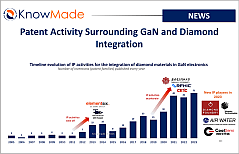
Featured image of the article Patent Activity Surrounding GaN and Diamond Integration.
SOPHIA ANTIPOLIS, France – July 30, 2024 │ GaN electronic devices, especially GaN-based high electron mobility transistors (HEMT), are increasingly used in RF and power [...]

SOPHIA ANTIPOLIS, France – April 25, 2024 │Get an update on the Power GaN patent landscape with Dr. Rémi Comyn. He gave an online lecture, [...]
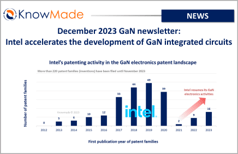
SOPHIA ANTIPOLIS, France – December 18, 2023 │ The GaN newsletter for December 2023 is now available! This monthly newsletter allows you to keep up [...]
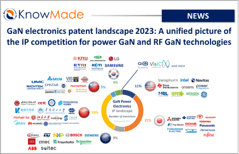
SOPHIA ANTIPOLIS, France – December 5, 2023 │ Knowmade is releasing a new GaN intellectual property (IP) report providing a deep dive into the power [...]
Featured image of a post about GaN.
SOPHIA ANTIPOLIS, France – November 29, 2023 │ Gallium nitride (GaN) power devices were successfully adopted in several power applications, starting with lateral GaN devices. [...]
SOPHIA ANTIPOLIS, France – November 16, 2023 │ The quarterly report for Q3 2023 GaN Electronics patent monitor is now available. This monitoring service allows [...]

SOPHIA ANTIPOLIS, France – October 27, 2023 │The GaN newsletter for October 2023 is now available! This monthly newsletter allows you to keep up to [...]

Reports

GaN Electronics Patent Lansdcape Analysis Next-Generation Power Modules Patent Landscape 2021

Monitors

Miniature of GaN Eletcronics patent monitor's cover. Miniature of GaN Newsletter's presentation page.
GaN Electronics Patent Monitoring Service GaN Newsletter

Conferences

Cover image of KnwoMade's analyst intervention at PE international 2023.
PE International 2023: our analyst’s intervention

Book contribution

Cover of the book GaN Technology.
GaN Technology

June 10, 2025

Power GaN and RF GaN companies strengthened patent portfolios in Q1 2025

SOPHIA ANTIPOLIS, France – June 10, 2025 │ KnowMade today announced the publication of its Q1 2025 IP report on GaN electronics, highlighting robust patenting activity across both power and RF segments. Amid on-going patent disputes between leaders in the power GaN device market, companies keep executing their strategy to address this market. Recent patent filings emphasize critical aspects of power GaN technology such as gate design and packaging, resulting in sustained patent portfolio growth. Meanwhile, key RF market players keep expanding their IP activities in the RF GaN landscape, underlining the technology’s critical role in next-generation wireless applications.

Combined bar chart showing the newly granted patent families and new patent families duing Q125 in the GaN electronics patent landscape.

Q1 2025 GaN Electronics IP Activity at a Glance

During the first quarter of 2025, a total of 540 new patent families were published, with Xidian University and major Chinese entities such as CETC and Innoscience leading the patent filings, followed by contributions from Nuvoton, STMicroelectronics, and Toshiba. Over 330 patent families were granted for the first time, notably reinforcing portfolios at Innoscience, STMicroelectronics, Infineon, Navitas, and EPC, alongside significant grants to Panasonic and TSMC. The quarter also saw more than 110 patents abandoned and over 70 patents expired, primarily from well-established patent holders including Wolfspeed, Infineon, and Fujitsu.

Approximately 10 IP collaborations (patent co-filings) were recorded, most partnerships formed between industry and academic organizations. For instance, Safran published a patent application with CNRS, CNAM and several universities in Paris, for an on-board aeronautical power circuit with active filtering. Also, Volkswagen cooperated with the University of Tennessee on GaN-based three-level active neutral point clamped power module designs, resulting in joint patent publications in Q1 2025.

Nearly 40 patent transactions took place this quarter, predominantly within China, such as the transfer of several RF GaN patents from Xidian University to Huawei and power module company Macmic Science & Technology’s acquisition of a GaN device patent from UESTC.

In addition, a new lawsuit was initiated in February 2025 when Innoscience appealed to the U.S. Court of Appeals to challenge the U.S. International Trade Commission’s ruling in last November on EPC’s patent US 8,350,294.

Top Innovators in Power GaN

Toshiba, Texas Instruments (TI), and Rohm each published more than six new inventions. In particular, Rohm introduced multiple innovations aimed at enhancing the reliability of normally-off GaN devices by leveraging p‑GaN gate layer techniques and superlattice buffer structures. TI unveiled a novel gate structure incorporating a p‑type poly‑Si layer to decouple parasitic capacitances and improve gate depletion behavior, alongside trench-based substrate-to-source connections for GaN power devices and a HEMT design featuring a doped barrier to boost threshold voltage stability and drain current stability. Moreover, TI disclosed a packaging solution wherein a GaN FET is co-packaged with its driver for optimized half-bridge modules.

Leading RF GaN Developments

Sony, Sumitomo Electric, and Macom disclosed six, five, and four RF-focused inventions, respectively. While Sumitomo Electric and Sony were focused on RF GaN device designs, Macom’s patenting activity related to RF amplifier circuitry and advanced packaging techniques.

Interestingly, Sumitomo Electric focused on RF GaN-on-SiC devices fabricated on nitrogen-polarity GaN epitaxial structures. Academic research also made a significant contribution on this topic with UCSB publishing an invention that improves the linearity of deep-recess GaN MIS‑HEMTs through corrugation of N-polar structures. MONDE Wireless, a UCSB spin-off, also mentioned N-polar GaN HEMTs grown on miscut substrates in another Q1-2025 patent publication.

Emerging players

New entrants to the GaN electronics IP landscape were predominantly Chinese, with LED manufacturer Anhui GaN Semiconductor filing several epiwafer patent applications for both power and RF uses, and battery manufacturer CATL submitting its first GaN-related invention targeting battery management systems. In the U.S., Tesla entered the arena with a packaged integrated circuit device featuring enhanced power surge heat dissipation, and Soctera, a Cornell University spin-off, proposed a GaN device structure using an AlN back barrier layer and in-situ two-step passivation process to mitigate current collapse.

KnowMade’s GaN Electronics Patent Monitoring Service

Subscribing to KnowMade’s GaN Electronics Quarterly Patent Monitor provides timely insights into emerging technologies and competitor activities. This service offers comprehensive quarterly analysis reports accompanied by an updated patent database, essential tools for tracking competitors’ IP developments and uncovering strategic opportunities.

The added value of this monitoring service lies in year-round access to a dedicated analyst, enabling you to request additional research on specific technologies or companies’ patent portfolios, and to customize the monitoring service by including specific players and/or segments to better suit your strategic needs.

Reach out to us at contact@knowmade.fr for subscriptions and further details.


Press contact
contact@knowmade.fr
Le Drakkar, 2405 route des Dolines, 06560 Valbonne Sophia Antipolis, France
www.knowmade.com

About KnowMade
KnowMade is a Technology Intelligence and IP Strategy consulting company specialized in analysis of patents and scientific information. The company helps innovative companies and R&D organizations to understand their competitive landscape, follow technology trends, and find out opportunities and threats in terms of technology and patents.
KnowMade’s analysts combine their strong technology expertise and in-depth knowledge of patents with powerful analytics tools and methodologies to turn patents and scientific information into business-oriented report for decision makers working in R&D, Innovation Strategy, Intellectual Property, and Marketing. Our experts provide prior art search, patent landscape analysis, scientific literature analysis, patent valuation, IP due diligence and freedom-to-operate analysis. In parallel the company proposes litigation/licensing support, technology scouting and IP/technology watch service.
KnowMade has a solid expertise in Compound Semiconductors, Power Electronics, Batteries, RF Technologies & Wireless Communications, Solid-State Lighting & Display, Photonics, Memories, MEMS & Solid-State Sensors/Actuators, Semiconductor Manufacturing, Packaging & Assembly, Medical Devices, Medical Imaging, Microfluidics, Biotechnology, Pharmaceutics, and Agri-Food.

July 30, 2024

Patent Activity Surrounding GaN and Diamond Integration

SOPHIA ANTIPOLIS, France – July 30, 2024 │ GaN electronic devices, especially GaN-based high electron mobility transistors (HEMT), are increasingly used in RF and power conversion applications. Yet in the most demanding applications, GaN device performance and reliability may be limited by thermal considerations such as the channel temperature. Some forms of enriched monocrystalline synthetic diamond have been shown to have the highest thermal conductivity of any known solid at room temperature 1. Because of this thermal conductivity, the integration of diamond into GaN electronic structures can significantly improve the thermal management of GaN devices. However, such integration has been technically challenging so far. In its latest GaN electronics reports, KnowMade highlights endeavors to leverage GaN with diamond integration in electronic devices based on the recent patent applications filed in this space.

This analysis was previously published in the June 2024 print edition of the Microwave Journal.

Many IP newcomers enter the field

The patent analysis is broad. It considers all patent applications claiming the integration of diamond with GaN electronics without distinction of the material, so it includes applications using single-crystal diamond, polycrystalline diamond and other varieties. The analysis does not differentiate as to the stage of the process where the diamond was integrated. This integration can be a passivation layer, a substrate, a heat sink or another use. It also does not distinguish whether the diamond was integrated as epitaxy, bonding or in some other fashion.

With these guidelines, Figure 1 describes the time evolution of intellectual property (IP) activities related to the technical challenge of integrating diamond materials with GaN. As Figure 1 shows, patenting activities were very limited in the 2000s, but they took off in the early 2010s. The driving forces behind the increase in patent activity were the efforts of pioneers such as Element Six and Group4 Labs.

Founded in 2003 as a U.S. startup company, Group4 partnered with Element Six in 2008. Group4 was subsequently acquired by Element Six in 2013. In 2016, newly established Akash Systems agreed with RFHIC to jointly negotiate the repurchase of Element Six’s GaN-on-diamond IP. Akash acquired all patents and other IP rights related to GaN-on-diamond technology for use in satellite communications and related markets.

Table showing the timeline evolution of IP Activities for the integration of diamond materials in GaN electronics.

Figure 1: Time evolution of patent family publications for the integration of diamond materials with GaN electronic devices.

In 2021, the number of patent filings increased sharply, mainly due to the acceleration of Chinese players such as CETC with 29 inventions and Xidian University with 44 inventions. Since 2021, a relatively stable patenting activity has been observed, supported by the entrance of more than 30 new IP players, especially Chinese research organizations like Wuhan University, Shenzhen University and Taiyuan University of Technology, along with Chinese industrial players like CoolSemi, CSMH and others.

Besides China, several players like Air Water in Japan, which collaborated with Osaka Metropolitan University, have entered the field recently. This collaboration co-filed patent WO2023/048160, published in early 2023. The patent publication was followed by a scientific paper released in late 2023 2. In this paper, researchers described a method based on the heteroepitaxy of GaN on a 3C-SiC layer formed on a silicon substrate. Then, the silicon substrate is removed and the GaN-on-3C-SiC stack is bonded to a thermally conductive support layer that can be made of either diamond or polySiC, according to the first patent claim. So far, about 30 patent families have disclosed methods based on bonding techniques to integrate diamond materials with GaN electronic devices.

However, bonding of GaN materials with a diamond substrate is technically challenging and alternative methods have been developed. For instance, Wonder CVD, a startup company founded in 2016 and headquartered in Dubai, entered the GaN electronics patent landscape in 2023, filing patent application US20230307249. It describes the growth of polydiamond on the silicon (111) thin layer of an SOI substrate, the removal of the base and oxide layers, followed by the heteroepitaxy of GaN on the other surface of the silicon (111) thin layer.

Another interesting example is the collaboration between imec and UHasselt in Europe that is described in patent EP4125113, although the patent application seems to have been abandoned since August 2023. The invention relates to the formation of a nanocrystalline diamond layer that forms a stable connection between a GaN material and a polydiamond material. In addition, the nanocrystalline diamond layer is expected to further facilitate heat dissipation for GaN electronic devices.

While the previous examples describe the integration of diamond materials in contact with or relatively close to the GaN device layer, US startup company Diamond Foundry entered the GaN electronics patent landscape in 2023 with a different approach. In patent application US20230411459, Diamond Foundry disclosed a diamond substrate that could be used as a packaging substrate for GaN or SiC devices intended as an alternative to silicon-based IGBT chips used in electric vehicle applications. Diamond Foundry is one of the few companies in this space targeting power applications. Overall, less than 10 percent of all inventions related to diamond integration explicitly target power electronics. Figure 2 shows a drawing from US20230411459 illustrating Diamond Foundry’s idea for their diamond substrate.

Illustration of diamond materials intergation in power electronics.

Figure 2: Patent application US20230411459, assigned to Diamond Foundry: A novel single-crystal diamond wafer enables significant advances in electric vehicle power electronics.

The IP Leaders

Comparing the number of pending patent applications with the number of granted patents for the main patent assignees provides valuable insight into the global IP competition for a given technology. Figure 3 shows this comparison for the integration of diamond materials with GaN electronics. Figure 3 plots the number of pending patent applications on the x-axis and the number of granted patents on the y-axis. At this intersection of these metrics, the size of the bubble represents the number of patent families selected for the study. The results of Figure 3 show that RFHIC stands as the current leader in GaN and diamond-related IP, but several RF GaN market players have positioned themselves as challengers. As can be seen, Akash Systems is the closest competitor to RFHIC, trailing slightly in patent applications and patents granted. However, companies like RTX Corporation, Mitsubishi Electric, Xidian University and CETC could pose strong future competition as all of them have more patent applications than RFHIC. Additionally, Mitsubishi Electric, Xidian University and CETC have comparable or much more breadth of GaN and diamond-related patent families. RFHIC’s current IP leadership is largely inherited from the patenting activities of Group4 and Element Six, although a few inventions were disclosed by RFHIC soon after the patent transaction, in 2018.

Graphic showing IP leadership in the sector of diamond integration in GaN electronics.

Figure 3: IP leadership of patent assignees filing patents related to the integration of diamond materials into GaN electronic devices.

In its 2023 GaN electronics IP report, KnowMade analyzed this IP leadership and pointed out RFHIC’s IP strength in GaN-on-diamond wafers and epiwafers, which is the very upward part of the RF GaN supply chain. In this part of the supply chain, RFHIC has no serious IP challengers but Xidian University. Because most of its patents are recent and exclusively filed in China, Xidian University’s IP leadership remains limited despite a relatively high number of inventions disclosed by the Chinese university. In contrast, RFHIC’s patent portfolio protects inventions in many different countries, especially in Europe, Japan, the U.S. and South Korea.

Details from 6 patents related to Gan/diamond.wafers

Figure 4: US patents related to GaN/diamond wafers recently granted to RFHIC.

Interestingly, RFHIC resumed its patenting activities in 2021 with the publication of seven new inventions related to GaN-on-diamond. At the same time, they confirmed a global IP strategy, especially for one invention protected by several foreign patents, including six U.S. patents. The invention relates to the transfer of a III-nitride layer from its silicon growth substrate to a support wafer via a diamond layer. Different aspects of the method have been protected through various patent applications. For instance, an intermediate layer between the III-nitride layer and the diamond layer (US11652146), a composite silicon/diamond support wafer (US11652146) and the deposition of the support wafer (e.g., with polyGaN or polysilicon in US11476335), the carrier wafer (e.g., a SiC carrier is mentioned in US11424328) and the formation of through holes in such engineered substrates, as described in patent applications US11901418 and US11901417. Drawings from these and other patents granted to RFHIC for GaN/diamond wafers are shown in Figure 4.

Just like RFHIC, U.S. company Akash Systems published only a few inventions after the patent acquisition from Element Six. Akash published two patent families in 2018, mentioning the integration of diamond at the device level as a substrate and package level as a base for improved thermal management in transmitters used in satellite communication (US10332820, US10374553). Interestingly, the U.S. startup company resumed its IP activities in 2020, publishing seven inventions aiming to increase its coverage of the RF GaN supply chain. These recent inventions relate not only to packages, modules and systems but also to wafers, epiwafers and devices.

Mitsubishi Electric started its patenting efforts in 2017 and has maintained a stable IP activity in the field. In contrast with other competitors aiming to protect inventions across the entire supply chain, Mitsubishi Electric’s IP strategy seems to focus on developing various aspects related to GaN-on-diamond device technology. Starting from an epiwafer, GaN layer transfer (US20230083507) and GaN bonding (US20220230920) techniques have been disclosed to integrate GaN devices with a diamond substrate. In an alternative approach, diamond may be integrated locally below the GaN devices with good adhesion characteristics and limited damage to the GaN epilayer. This concept is shown in Figure 5 with a drawing from US10720374 granted to Mitsubishi Electric in 2020. Additionally, the company has several patents related to the fabrication of GaN devices on recessed diamond substrates (e.g., US11482464).

Scheme of the result of layering diamond on nitride.

Figure 5: Formation of a diamond layer on a nitride layer (Mitsubishi Electric, US10720374, granted in 2020).

Conclusion

IP activities related to the integration of diamond materials into GaN electronics devices have remained marginal in the GaN electronics patent landscape. For comparison, these activities represent less than 10 percent of all inventions related to RF GaN disclosed in 2023. Yet the analysis of the IP competition highlights a significant activity in recent years from several market players, in terms of the number of inventions disclosed by these players and the volume of patent applications filed to protect some of their key inventions in multiple countries. Additionally, since there is a limited number of well-established players in this space, there seems to be an opportunity for newcomers to make a breakthrough in this landscape, not only in terms of technology but also in terms of IP.

References

[1]

en.wikipedia.org/wiki/Material_properties_of_diamond#Thermal_conductivity

[2]

onlinelibrary.wiley.com/doi/10.1002/smll.202305574


Press contact
contact@knowmade.fr
Le Drakkar, 2405 route des Dolines, 06560 Valbonne Sophia Antipolis, France
www.knowmade.com

About the author
Rémi Comyn works for KnowMade as a Patent Analyst in the field of Compound Semiconductors and Electronics. He holds a PhD in Physics from the University of Nice Sophia Antipolis (France) in partnership with CRHEA-CNRS (Sophia Antipolis, France) and the University of Sherbrooke (Québec, Canada). Rémi previously worked in compound semiconductors research laboratory as Research Engineer.

About KnowMade
KnowMade is a Technology Intelligence and IP Strategy consulting company specialized in analysis of patents and scientific information. The company helps innovative companies and R&D organizations to understand their competitive landscape, follow technology trends, and find out opportunities and threats in terms of technology and patents.
KnowMade’s analysts combine their strong technology expertise and in-depth knowledge of patents with powerful analytics tools and methodologies to turn patents and scientific information into business-oriented report for decision makers working in R&D, Innovation Strategy, Intellectual Property, and Marketing. Our experts provide prior art search, patent landscape analysis, scientific literature analysis, patent valuation, IP due diligence and freedom-to-operate analysis. In parallel the company proposes litigation/licensing support, technology scouting and IP/technology watch service.
KnowMade has a solid expertise in Compound Semiconductors, Power Electronics, Batteries, RF Technologies & Wireless Communications, Solid-State Lighting & Display, Photonics, Memories, MEMS & Solid-State Sensors/Actuators, Semiconductor Manufacturing, Packaging & Assembly, Medical Devices, Medical Imaging, Microfluidics, Biotechnology, Pharmaceutics, and Agri-Food.

April 25, 2024

Webinar – Current and emerging trends in the power GaN patent landscape

SOPHIA ANTIPOLIS, France – April 25, 2024 │Get an update on the Power GaN patent landscape with Dr. Rémi Comyn. He gave an online lecture, and you can find a report and the materials he posted here.

Webinar video recording


About the subject

Since 2019, KnowMade has been researching and monitoring the intellectual property (IP) landscape across the whole power GaN value chain: from wafers to epiwafers, devices, packaging, modules, circuits, and applications. The webinar will describe the recent evolutions in power GaN-related patenting activities, focusing on the most competitive IP spaces in this landscape: e-mode GaN transistor technology and GaN power IC. Eventually, emerging IP trends in power GaN technology related to vertical devices, packaging, and modules, will be discussed.

Webinar presentation slides

About the author

Rémi Comyn works for KnowMade as a Patent Analyst in the field of Compound Semiconductors and Electronics. He holds a PhD in Physics from the University of Nice Sophia Antipolis (France) in partnership with CRHEA-CNRS (Sophia Antipolis, France) and the University of Sherbrooke (Québec, Canada). Rémi previously worked in compound semiconductors research laboratory as Research Engineer.

December 18, 2023

December 2023 GaN newsletter: Intel accelerates the development of GaN integrated circuits

SOPHIA ANTIPOLIS, France – December 18, 2023 │ The GaN newsletter for December 2023 is now available! This monthly newsletter allows you to keep up to date on the latest scientific publications, patent applications, and news related to III-Nitride semiconductors (GaN, AlN, InN, and alloys) for optoelectronic and electronic applications (power, RF, LED, laser, photonics, and so on). This month, let us highlight Intel’s latest developments in GaN electronics to address the increasing power density and efficiency needs of data centers and networking platforms.

Intel advances GaN IC technology for power management

In December’s issue, KnowMade reports on a recent news from Intel. At IEDM 2023, the company introduced its DR (driver) GaN or DrGaN, which monolithically integrates a CMOS driver with GaN power switches on a 300mm GaN-on-Si platform. This work shows that it is possible to co-integrate the Si PMOS transistor with GaN transistors while maintaining the high figure of merit (FoM) to keep up with the growth of power density. According to the company, the new DrGaN device can address the power requirements of future CPUs and GPUs, showing excellent resistance and leakage performance. This is made possible by the development of a new gate-last process flow for 3D monolithic integration of GaN and Si CMOS, that leverages layer transfer technology (Figure 1). Interestingly, using this technological approach, Intel circumvents the challenging task of fabricating p-channel GaN devices, that would be required in a DrGaN device integrally made of GaN.

Graphical illustration presenting Intel’s new gate-last process flow for 3D monolithic integration of GaN and Si CMOS by layer transfer.

Figure 1: (a) The new process flow for the 3D monolithic integration of GaN and Si CMOS by layer transfer. (b) The new 3D monolithic integration of GaN and Si CMOS by this process. (c) The layout of a 40×10µm2 180nm DrGaN unit cell. Source: Paper 9.7, “DrGaN: an Integrated CMOS Driver-GaN Power Switch Technology on 300mm GaN-on-Si with E-mode GaN MOSHEMT and 3D Monolithic Si PMOS,” H.W. Then et al, Intel, IEDM 2023.

Yet this approach also rises major challenges related to the integration of Si and GaN technologies, especially challenges due to the thermal budget of their respective processes. As shown in Figure 1, Intel aims to address this challenge by completing the high-temperature activation steps for the Si CMOS transistors before depositing the GaN transistor’s gate dielectric. What’s more, this method allows GaN and Si CMOS transistors to share the same backend interconnect stack, which reduces resistance and mask count. With a FoM of 0.59 (mΩ-nC)-1 for a 30nm gate-length GaN MOS-HEMT, the new technology exhibits a promising potential for future scaling of the architecture.

This achievement is another milestone after previous breakthroughs in RF and power GaN technologies. It accelerated in 2018/2019 with the first report on the development of a 300-mm GaN-on-Si technology, dedicated to power supply of user equipment and future use of mmW frequencies for wireless LAN capability. Last year, Intel announced a 20X improvement over state-of-the-art e-mode p-GaN HEMT in a key FoM for power delivery (Figure 2). Concomitantly, with the same device architecture, Intel announced record cutoff frequencies, a critical FoM for communications.

Intel’s research breakthroughs on GaN-on-Silicon technology presented at IEDM 2022.

Figure 2: Intel’s previous research breakthroughs introduced at IEDM 2022. Source: Scaled submicron field-plated e-mode high-K GaN transistors on 300mm Si(111) wafer with power FoM (RON xQGG) of 3.1 mohm-nC at 40V and fT/fMAX of 130/680GHz, IEEE Int. Electron Devices Meeting Tech. Dig., 111 (2022), pp. 35.1.1-35.1.4.

In the power GaN landscape, Intel competes with Navitas, Cambridge GaN Devices (CGD), EPC and others that have been developing power GaN integrated circuits (IC). Yet Intel stands out as the only company to focus on harnessing efficiency of GaN for 48V and below, according to Paul Fisher, Director of Chip Mesoscale Process Development at the Components Research at Intel. In the RF GaN landscape, Intel stands out as one of the main players actively pushing GaN-on-Si technology with Infineon, MACOM, GlobalFoundries and others. Their advances in GaN devices and circuits at higher mm-wave frequencies were reviewed by a recent paper from Fraunhofer IAF and Albert-Ludwigs-Universität Freiburg that KnowMade reported in the GaN newsletter earlier this year. What’s more, apart from the recent conference papers, Intel published a couple of scientific papers in 2023, describing e-mode 300-mm GaN-on-Si(111) with integrated Si CMOS, for future mm-wave RF applications (published in April) and dealing with the assessment of T-Gate and Π -Gate HEMT, through cellular Monte Carlo simulations (co-published with Arizona State University in September). In the first paper, Intel’s principal engineer Han Wui Then et al. reported a new record fMAX  = 700 GHz ( fT = 115 GHz) with an LG = 50 nm GaN MOS-HEMT having a submicrometric source field plate fabricated using a 300-mm GaN MOS-HEMT process with integrated Si CMOS.

Intel has resumed its IP activities in GaN electronics

KnowMade recently published a GaN electronics IP report analyzing both RF and power GaN patent landscapes. Intel entered the GaN electronics patent landscape in 2013 and accelerated its IP strategy in 2017-2019 (Figure 3), with a focus on GaN-on-Si technology. While GaN-on-Si is the mainstream platform for power applications, it has not been adopted yet in RF applications, where the GaN-on-SiC platform dominates. KnowMade’s report analyzed the position of the main players in the RF GaN IP competition. Interestingly, Intel stands as one of the best-established players for GaN-on-Si epiwafers, and as an undisputable leader for GaN-on-Si devices, far ahead of its main challengers such as MACOM and TSMC.

Graphical illustration presenting the time evolution of Intel’s patent publications related to GaN electronics over the past decade.

Figure 3: Intel’s patenting activity in the GaN electronics patent landscape (source: GaN electronics patent landscape report, KnowMade, November2023)

The number of GaN electronics patent publications abruptly dropped in 2021, following COVID-19 pandemic. This sharp decrease in patent filings has not been observed only for GaN electronics, since Intel’s patent filings overall dropped by 50% from 2019 to 2020. Yet Intel has maintained most of its GaN electronics patents alive during this break. What’s more, Intel has resumed its patenting activity in the GaN electronics field lately, confirming the position of GaN electronics in its technology roadmap. Indeed, more than 15 new patent applications were published by Intel in 2023, identified in KnowMade’s GaN newsletter and analyzed in more details in KnowMade’s GaN electronics patent monitor. This inventive activity is led by two main inventors: Principal Engineer Han Wui Then and Integration Group Leader Marko Radosavljevic. The recent patent publications describe several inventions leveraging layer transfer technology for GaN IC fabrication, such as US20230090106, US20230069054, US20230197732 and US20230054719. Furthermore, other recent inventions address critical aspects of the gate structure (e.g., patent US20230197840, Figure 4).

Drawing of gate structure claimed in recent Intel’s patent application US20230197840 enabling lower subthreshold slope in GaN transistors.

Figure 4: Gate structure to enable lower subthreshold slope in GaN transistors (US20230197840)

Eventually, the GaN electronics IP report highlights an IP strategy centered on the US (200+ patent applications) and Taiwan (90+). Intel’s patenting activity for GaN electronics has been relatively limited in other countries. Yet the strongest progression in patent filings is presently seen in Europe, which is consistent with the recent ambitions of Intel to expand its activities in Europe, from R&D and manufacturing all the way to packaging.


Press contact
contact@knowmade.fr
Le Drakkar, 2405 route des Dolines, 06560 Valbonne Sophia Antipolis, France
www.knowmade.com

About the author
Rémi Comyn works for KnowMade as a Patent Analyst in the field of Compound Semiconductors and Electronics. He holds a PhD in Physics from the University of Nice Sophia Antipolis (France) in partnership with CRHEA-CNRS (Sophia Antipolis, France) and the University of Sherbrooke (Québec, Canada). Rémi previously worked in compound semiconductors research laboratory as Research Engineer.

About KnowMade
KnowMade is a Technology Intelligence and IP Strategy consulting company specialized in analysis of patents and scientific information. The company helps innovative companies and R&D organizations to understand their competitive landscape, follow technology trends, and find out opportunities and threats in terms of technology and patents.
KnowMade’s analysts combine their strong technology expertise and in-depth knowledge of patents with powerful analytics tools and methodologies to turn patents and scientific information into business-oriented report for decision makers working in R&D, Innovation Strategy, Intellectual Property, and Marketing. Our experts provide prior art search, patent landscape analysis, scientific literature analysis, patent valuation, IP due diligence and freedom-to-operate analysis. In parallel the company proposes litigation/licensing support, technology scouting and IP/technology watch service.
KnowMade has a solid expertise in Compound Semiconductors, Power Electronics, Batteries, RF Technologies & Wireless Communications, Solid-State Lighting & Display, Photonics, Memories, MEMS & Solid-State Sensors/Actuators, Semiconductor Manufacturing, Packaging & Assembly, Medical Devices, Medical Imaging, Microfluidics, Biotechnology, Pharmaceutics, and Agri-Food.

December 5, 2023

GaN electronics patent landscape 2023: A unified picture of the IP competition for power GaN and RF GaN technologies

SOPHIA ANTIPOLIS, France – December 5, 2023 │ Knowmade is releasing a new GaN intellectual property (IP) report providing a deep dive into the power GaN and RF GaN electronics patents worldwide. In this report, both power GaN and RF GaN patent landscapes have been analyzed in a view to describe the global IP competition across the whole supply chains and the local ecosystems emerging to support the industrialization of GaN technologies.

More and more players exhibit a common IP strategy for power GaN and RF GaN technologies

In addition to power GaN and RF GaN patents, KnowMade’s GaN Electronics IP report considers the impact of generic GaN electronics patents, applicable to both power and RF applications, on the global IP competition (Figure 1).

Graphical illustration presenting the main companies holding power GaN patents, RF GaN patents and generic GaN electronic patents

Figure 1: Main companies in the GaN electronics patent landscape.

For instance, some companies, such as United Microelectronics Corporation (UMC), don’t limit the application scope in most of their GaN electronics inventions, showing a common IP strategy for both RF and power markets. What’s more, well-established power GaN market players, such as Infineon Technologies and Innoscience, own high numbers of generic GaN electronics patents, that could be leveraged for RF applications in the next few years.

Power GaN patent landscape: a focus on national and regional ecosystems

The inventive activity used to be dominated by Japanese players (2001 – 2015) until Chinese players took over the IP leadership in 2016. As a result, Japanese and Chinese players have produced more than 70% of all power GaN inventions together (Figure 2). Such intensive patenting activities are eclipsing important IP trends occurring in other regions (US, Europe, etc.). KnowMade’s GaN Electronics report unveils such IP trends providing separate analyses of the regional ecosystems in the power GaN patent landscape.

Graphical illustration of main patent assignees in the power GaN patent landscape, split by country

Figure 2: Main players in the power GaN patent landscape, split by country.

The GaN Electronics Patent Landscape report points out that most of the historical Japanese IP players are focusing on monetizing their power GaN IP portfolios (Sharp, Furukawa Electric, NTT, Fujitsu). Few of them are still actively filing patent applications to consolidate their IP position, but Fujitsu and Panasonic, in different parts of the supply chain. However, new Japanese IP leaders such as ROHM and Sumitomo Chemical are now aiming to turn their IP leadership into market leadership.

Taiwanese players are rising in the power GaN IP landscape, with most of the main Taiwanese foundries ramping up their activities across the power GaN supply chain, following TSMC’s lead. The Taiwanese IP activities highlight a reinforcement of the domestic supply chain for power GaN technology, with major players actively filing patents in the upstream supply chain (e.g., GlobalWafers) and accelerating their patent filings in the downstream supply chain (e.g., Delta Electronics). What’s more, several newcomers have entered the power GaN IP landscape in Taiwan lately.

The US-China trade war adds a new dimension to the power GaN IP competition, urging players to adapt their strategy in a view to secure the development of their power GaN activities internationally. In this context, several Chinese players such as Innoscience and Huawei are expanding their IP activities worldwide, looking to compete in the US and European markets.

Most of the main US market players don’t have a complete IP coverage of the power GaN supply chain. Instead, US players leverage IP and manufacturing partnerships and/or existing IP and know-how developed for other power semiconductor technologies (Si, SiC). According to their own patenting activities, main US market players are consolidating their own IP position in Asia and Europe, to support the development of their market activities outside the US.

Infineon is the main vertically integrated innovator in the power GaN IP landscape, with a global IP strategy aiming to cover the main important regions for power electronics. Since 2015, Infineon has successfully leveraged multiple acquisitions (GaN Systems, International Rectifier) and IP partnerships (Panasonic) in a view to accelerate its strategy in the power GaN market. In Europe, major research organizations (Cea, imec, Fraunhofer) are driving the establishment of a domestic supply chain, leading to the establishment of new startup companies, and to the emergence of more vertically integrated innovators such as STMicroelectronics.

RF GaN patent landscape: a look into the IP strategies of key players across the supply chain

The GaN Electronics Patent Landscape report highlights different views from RF GaN market players about what innovation will be critical to protect in order to impact the future RF GaN supply chain (Figure 3). For instance, several incumbent players in the RF GaN market seem to consider wafer and epiwafer IP as less critical, while others, such as Sumitomo Electric, Raytheon and Mitsubishi Electric, are still competing in this IP space. Most vertically integrated players identified in this report are still focusing on the IP related to RF GaN devices. In this regard, NXP stands out as it soon shifted its focus to the downstream supply chain. It was followed by most of the main RF GaN market players which are now consolidating their IP position in packaging, modules, circuits and applications.

In recent years, Wolfspeed has taken over the IP leadership across the whole RF GaN supply chain, except for wafers and epiwafers (Figure 3). Just like Wolfspeed, MACOM has been actively filing patents across the RF GaN supply chain. Yet unlike Wolfspeed, MACOM’s IP activity did not translate into a global IP leadership. With the acquisition of Wolfspeed’s RF business, MACOM is expected to catch up with the competition in the global RF GaN IP landscape. Interestingly, this acquisition virtually positions MACOM as an undisputable IP leader for circuits and applications. Another stand-out player emerging in the RF GaN patent landscape is Mitsubishi Electric: it is currently the only vertically integrated innovator which is still competing across the whole RF GaN supply chain.

In contrast with the power GaN patent landscape, US players have established a complete IP coverage of the RF GaN supply chain and this IP ecosystem have been reinforced by many startup companies actively filing patent applications in different part of the supply chain during the last decade (Akoustis, Akash Systems, Eridan, Finwave, etc.). The analysis of their IP strategies shows that US companies are now expanding their patenting activities outside the national territory, especially in Europe, China and Taiwan, to support their international ambitions in the growing RF GaN market.

This graphical illustration presents the number of granted patents and pending patent applications held by main patent assignees in the upstream and the downstream parts of the RF GaN supply chain.

Figure 3: IP leadership of patent assignees in the upstream part (wafers, epiwafers, devices) and the downstream part (packaging, modules, circuits, applications) of the RF GaN supply chain.

In the wafer and epiwafer IP space, the competition is now taking multiple and different directions: GaN-on-Si (IQE, Shin Etsu), GaN-on-diamond (RFHIC, Akash Systems), GaN-on-engineered substrates (Soitec, Qromis, Shin Etsu), GaN-on-AlN (Fujitsu), in addition to the mainstream GaN-on-SiC platform (Sumitomo Electric, Sumitomo Chemical). Regarding the GaN-on-Si platform, the GaN Electronics IP report highlights a reduction in patent filings from most well-established IP players. In this context, Intel continues to lead the competition in the RF GaN-on-Si IP landscape, especially for RF GaN-on-Si devices. Aside from Intel, MACOM and TSMC are the main established IP players still actively filing patent applications for RF GaN-on-Si technology. Interestingly, the other Taiwanese foundries are following TSMC’s lead. What’s more, many power GaN IP players were seen to file RF GaN patent applications lately (Innoscience, Infineon, ST), indicating the development of RF GaN devices in a view to enter the RF telecom market with GaN-on-Si and/or other unconventional platforms such as engineered substrates (Qromis-VIS) or semi-insulating SiC on conductive SiC substrates (ROHM).

For a decade, Knowmade has investigated the full spectrum of GaN technology providing numerous GaN IP reports in optoelectronics, RF, and power electronics. What’s more, Knowmade’s GaN newsletter and patent monitoring services provide you with the latest updates on GaN technology and the flexibility to focus on the most critical aspects depending on your markets and your position in the value chain.


Press contact
contact@knowmade.fr
Le Drakkar, 2405 route des Dolines, 06560 Valbonne Sophia Antipolis, France
www.knowmade.com

About the author
Rémi Comyn works for KnowMade as a Patent Analyst in the field of Compound Semiconductors and Electronics. He holds a PhD in Physics from the University of Nice Sophia Antipolis (France) in partnership with CRHEA-CNRS (Sophia Antipolis, France) and the University of Sherbrooke (Québec, Canada). Rémi previously worked in compound semiconductors research laboratory as Research Engineer.

About KnowMade
KnowMade is a Technology Intelligence and IP Strategy consulting company specialized in analysis of patents and scientific information. The company helps innovative companies and R&D organizations to understand their competitive landscape, follow technology trends, and find out opportunities and threats in terms of technology and patents.
KnowMade’s analysts combine their strong technology expertise and in-depth knowledge of patents with powerful analytics tools and methodologies to turn patents and scientific information into business-oriented report for decision makers working in R&D, Innovation Strategy, Intellectual Property, and Marketing. Our experts provide prior art search, patent landscape analysis, scientific literature analysis, patent valuation, IP due diligence and freedom-to-operate analysis. In parallel the company proposes litigation/licensing support, technology scouting and IP/technology watch service.
KnowMade has a solid expertise in Compound Semiconductors, Power Electronics, Batteries, RF Technologies & Wireless Communications, Solid-State Lighting & Display, Photonics, Memories, MEMS & Solid-State Sensors/Actuators, Semiconductor Manufacturing, Packaging & Assembly, Medical Devices, Medical Imaging, Microfluidics, Biotechnology, Pharmaceutics, and Agri-Food.

November 29, 2023

Next-generation power devices: Status of the IP competition for vertical GaN power devices

SOPHIA ANTIPOLIS, France – November 29, 2023 │ Gallium nitride (GaN) power devices were successfully adopted in several power applications, starting with lateral GaN devices. Following the release of its new GaN electronics IP report, KnowMade discusses the status of vertical GaN device technology in the power GaN patent landscape. With the potential to overcome breakdown voltage and current capacity limitations of lateral devices, while alleviating some thermal issues, vertical GaN is seen as a promising technology for the next generation of power devices.

China takes over the leadership from Japan in vertical GaN inventive activity

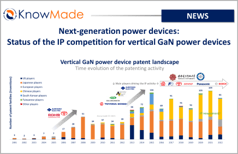
According to the patenting activities (Figure 1), the intellectual property (IP) development of vertical GaN power devices took off in the mid-2000s, under the leadership of Japanese companies (Sumitomo Electric, ROHM, Toyota Motor). Yet the number of inventions per year remained relatively low until 2012. In 2013, the inventive activity sharply increased, driven by Sumitomo Electric, Toyoda Gosei, Seoul Semiconductor and Avogy (whose power GaN patents were transferred to NexGen Power Systems in 2017). Since 2015, the IP activities for vertical GaN power devices have reached a plateau, with new leading innovators such as Fuji Electric, Denso, Panasonic and Bosch. Notably, Chinese players – led by Chinese research organizations Xidian University and UESTC – seem to have taken the lead in the inventive activity, outperforming Japanese players year after year since 2020.

Graphical illustration of the time evolution of patent publications related to vertical GaN power devices over the past two decades.

Figure 1: Time evolution of patent publications related to vertical GaN power devices since 2001.

Most IP newcomers in vertical GaN come from China

The main IP newcomers that have entered the patent landscape since 2019 are Chinese research organizations, such as Shandong University and Xi’an Jiaotong University, and Chinese companies. One of them is GLC Semiconductor (聚力成半导体), a startup company founded in 2018. GLC focuses on the development and production of GaN epiwafers, and provides GaN chip design, production, packaging, and testing services. The company disclosed several inventions in 2020 related to vertical GaN FET structures, with its chairman, Yeh Shun-Min (叶顺闵), as the inventor. Interestingly, unlike most Chinese players seeking for protection of their inventions in China only, GLC has successfully filed several patent applications in the US (US11411099, US10854734) and Taiwan, in addition to China.

Outside China, some notable players entered this IP space, such as imec in 2020, following a collaboration with Ghent University aiming to develop semi-vertical and vertical GaN power devices (US20220406926, EP3627559). Concomitantly, imec has developed an approach to co-integrate vertical GaN power diodes and transistors (US11380789). Interestingly, other major European research organizations have resumed their IP activities in this field since 2019, including Cea. The French research organization has been collaborating with CNRS for the development of new vertical GaN power devices (US20230136949) and published two additional inventions in 2022 describing vertical GaN FETs (US20220310790) and diodes (US20220037538). In the US, Odyssey Semiconductor, a startup founded in 2019 by researchers from Cornell University Rick Brown and James Shealy, entered the vertical power GaN device patent landscape in 2022, with a first patent family (invention) describing a vertical GaN FET (US11652165, US11251295).

Japanese well-established IP players challenged by NexGen and Bosch

Following Avogy’s bankruptcy in 2017, its CEO Dinesh Ramanathan founded a startup company, NexGen Power Systems, which acquired Avogy’s power GaN patents. In 2021, NexGen started its own patenting activity in this field. Since then, it has published more than 10 inventions, including several patent applications related to vertical GaN FinFETs (e.g., US20230260996 and US20230246027). Such vertical devices have also been developed by Bosch since 2012, as indicated by a first patent publication in 2014 (US9525056). Yet Bosch has not been active in this field until 2019 and, in 2021, the company accelerated its IP strategy for vertical power GaN technology with more than 15 new patent families (inventions) including patent applications US20220310836 and US20220285542.

Graphical illustration of main patent assignees in the field of vertical GaN power devices.

Figure 2: The main players driving the inventive activity related to vertical GaN power devices since 2000.

So far, Japanese main innovators have not been challenged by Chinese companies but by Chinese research organizations, especially Xidian University and UESTC (Figure 2). These Chinese universities are focusing on China to protect their inventions, and it remains to be seen how they will leverage their patent portfolios to support the development of a domestic vertical GaN technology. By way of example, in the fast-developing power SiC industry, we have seen such organizations driving the emergence of new domestic players through partnerships and patent transfers. For GaN electronics, KnowMade has implemented several monitoring tools to detect the entry of new players in the patent landscape and in the scientific landscape.

Although Japanese players own the largest patent portfolios for vertical GaN power devices in terms of inventions (Figure 2), their impact on the IP competition is very contrasted (Figure 3). For instance, Sumitomo Electric, which has been the main innovator in this space, seems to be no longer competing for vertical GaN power devices: the company abandoned 70% of its patents protecting its vertical GaN inventions. Within Toyota group, several companies such as Toyoda Gosei, Toyota Motor and Denso have been actively filing vertical GaN patents. As a result, Toyota group stands out as an undisputed IP leader in this space. However, these companies have followed quite different trajectories in the vertical GaN power device IP landscape over the years (Figure 3).

This graphical illustration presents the number of alive patents related to vertical GaN power devices held by the main patent assignees.

Figure 3: The global IP competition for vertical GaN power devices.

Starting filing patents in the 2000s, Toyota Motor is one of the main historical players in this landscape, with Sumitomo Electric and Fuji Electric. Yet its IP leadership remained limited until Toyota initiated a partnership in 2018 with Denso, a new player in this space, to accelerate the development of power GaN technology, leading to more than 20 patent co-filings. The ownership of several vertical GaN patent co-filings has been transferred to Denso since then, confirming that Denso took the leadership in this collaboration. In contrast, Toyoda Gosei started actively publishing vertical GaN patent applications much later than Toyota Motor, in 2014, describing the development of vertical GaN MISFET. Toyoda Gosei stopped its IP activities in 2021, after positioning itself as the best-established IP player in this space, owning the highest number of granted patents for vertical GaN power devices. Lately, Toyoda Gosei announced a successful collaboration with Osaka University to develop 6-inch diameter GaN substrates targeting power devices.

Following Toyota group’s lead, Fuji Electric and NexGen emerged as the main IP leaders for vertical GaN power devices, with Bosch as the main IP challenger. As shown in Figure 3, Xidian University is closing the gap with other leading IP players, although its IP activity has been limited to China so far.

The main IP battlefield for vertical GaN technology lies in the US

The US count the largest number of granted patents for vertical GaN power devices, ahead of Japan. Indeed, most of the well-established IP players in this space are Japanese players which have focused their IP strategy on the US territory, in addition to their headquarters country (Figure 4). Yet according to the current IP trend, China may become shortly the most crowded space in terms of vertical GaN patents.

This graphical illustration highlights the geographical coverage of the main players' patent portfolio on vertical GaN power devices.

Figure 4: IP strategies of main players competing worldwide.

As of 2023, Japanese players don’t aim to extend their IP leadership to other countries (China, South Korea, Taiwan, Germany). Apart from Japanese players, main IP players are not interested in protecting their inventions in Japan. Instead, NexGen is aiming at strengthening its IP position in China. Unsurprisingly, most Chinese players focus their IP activities on the national territory and have shown no significant IP activities in the other countries. Likewise, Bosch has almost limited its IP activities to Europe so far, filing only 3 US patents and 2 Chinese patents. Still, several PCT applications have been filed lately by Bosch and might result in more patent applications in these countries. As the vertical GaN technology increases in maturity and finds new applications, we expect IP players with a view to enter power GaN market with vertical devices to extend the geographic coverage of their patenting activities, i.e., to protect their key inventions in the main power electronics markets.

After 20 years of innovation, the IP competition for vertical GaN technology has just started

Although more than 1,000 patent families (inventions) have been filed to cover the development of vertical GaN technology since the 2000s, the IP competition has been remarkably moderate so far. This situation reflects a relatively limited investment in vertical GaN device technology. For comparison, more than 6,000 inventions have been disclosed for power SiC devices so far, a technology that would be in direct competition with vertical GaN in power applications. Yet both technologies have shared similar technical issues in terms of material and device processing, which have made particularly challenging for them to reach the maturity required in high-power and high-temperature applications.

However, several players, including incumbent automotive companies, are still investing in vertical GaN technology. Indeed, several established IP players (Fuji Electric, NexGen, Toyota Motor) and relatively new IP players (Denso, Bosch) are accelerating their patent filings. Accordingly, the vertical GaN patent landscape is expected to become increasingly competitive in the next decade. Importantly, as this technology proves itself, several well-established IP players in the field might resume their IP activities to prepare for industrialization and commercialization of the vertical GaN power devices (ROHM, Seoul Semiconductor, Sumitomo Electric).

For a decade, Knowmade has investigated the full spectrum of GaN technology providing numerous GaN IP reports in optoelectronics, RF, and power electronics. What’s more, Knowmade’s GaN newsletter and patent monitoring services provide you with the latest updates on GaN technology and the flexibility to focus on the most critical aspects depending on your markets and your position in the value chain.


Press contact
contact@knowmade.fr
Le Drakkar, 2405 route des Dolines, 06560 Valbonne Sophia Antipolis, France
www.knowmade.com

About the author
Rémi Comyn works for KnowMade as a Patent Analyst in the field of Compound Semiconductors and Electronics. He holds a PhD in Physics from the University of Nice Sophia Antipolis (France) in partnership with CRHEA-CNRS (Sophia Antipolis, France) and the University of Sherbrooke (Québec, Canada). Rémi previously worked in compound semiconductors research laboratory as Research Engineer.

About KnowMade
KnowMade is a Technology Intelligence and IP Strategy consulting company specialized in analysis of patents and scientific information. The company helps innovative companies and R&D organizations to understand their competitive landscape, follow technology trends, and find out opportunities and threats in terms of technology and patents.
KnowMade’s analysts combine their strong technology expertise and in-depth knowledge of patents with powerful analytics tools and methodologies to turn patents and scientific information into business-oriented report for decision makers working in R&D, Innovation Strategy, Intellectual Property, and Marketing. Our experts provide prior art search, patent landscape analysis, scientific literature analysis, patent valuation, IP due diligence and freedom-to-operate analysis. In parallel the company proposes litigation/licensing support, technology scouting and IP/technology watch service.
KnowMade has a solid expertise in Compound Semiconductors, Power Electronics, Batteries, RF Technologies & Wireless Communications, Solid-State Lighting & Display, Photonics, Memories, MEMS & Solid-State Sensors/Actuators, Semiconductor Manufacturing, Packaging & Assembly, Medical Devices, Medical Imaging, Microfluidics, Biotechnology, Pharmaceutics, and Agri-Food.

November 15, 2023

Q3 2023 GaN electronics patent monitor report: GaNcool, a new pure player joining power GaN competition

SOPHIA ANTIPOLIS, France – November 16, 2023 │ The quarterly report for Q3 2023 GaN Electronics patent monitor is now available. This monitoring service allows you to keep up to date on GaN-related patent activity for RF & Power electronics: new patent publications, newly granted patents, patents expired or abandoned, latest patent transfers and patent litigation.

This quarter, let us focus on a new entrant in the power GaN IP landscape: GaNcool.

Anticipating opportunities and risks through patent watch

Gallium nitride (GaN) is the technology of choice for applications that require high frequency, high voltage, and high-power density. GaN has made impressive progress in material and process technologies, resulting in significant improvements in device performance for both power and RF applications. Today, more and more companies are adopting GaN devices into their electronics components, making GaN market more competitive. Patenting your innovative technology grants you a monopoly on your invention and protect it from its use by competitors in countries where your patent is in force. However, you also must be sure that what you intend to put on the market is not in the claims’ scope of patents from competitors. To manage that risk, Knowmade provides you with a reliable GaN Electronics patent monitoring service, which regularly follows patents from publication, and granting until they expire or are abandoned. Our quarterly patent monitor’s reports and databases not only give you a clear vision of your competitors’ strategies and future intentions, but also help you keep track of the latest technology and early detect new entrants in your business field. Through our GaN Electronics patent monitor, you can visualize existing technology and its trends that inform your present strategy and help you build a business strategy suitable for the future market.

Power GaN applications drive the GaN electronics patent activities

In our quarterly analysis, the GaN electronics patents are categorized into different segments of applications, supply chains, and technical challenges. The temporal evolution of new patent applications by segments reflects the level of investment in R&D and helps you visualize the technological and market trends. Let’s take an example of application segmentation, in which the new patent families (inventions) are divided into RF and power applications.

Graphical illustration of the percentage of new patent publications per application (RF, power, non-specific, other) over the last three years.

Figure 1: Distribution of new patent families by application over the last three years (source: Knowmade’s GaN Electronics Quarterly Patent Monitor).

It is obviously seen in figure 1 that, over the last three years, from 2021 to 2023, the share of new patent publications related to GaN RF fell slowly from 30% to 20% of the total published GaN electronics patents whereas the space of GaN power tended to increase from 50% to 60%. To meet the growing demands for automotive, e-mobility, and power supply for data centers, GaN intellectual property (IP) leaders such as Mitsubishi Electric, Texas Instruments, Infineon, Rohm, Innoscience, and Fuji Electric, have stepped up their patent activities in power GaN applications since 2021. Additionally, new entrants, mainly from China, are also focusing on expanding their IP activities for power GaN applications. In Q3 2023, over 15 IP newcomers were identified in GaN electronics patent landscape, more than half of them are Chinese entities, with around 60% of their new inventions related to power applications. Among the IP newcomers, we noticed a GaN pure player – GaNcool – whose patent publications are analyzed in the following section.

GaNcool, a new GaN pure player entering power GaN competition

GaNcool (Fuzhou Gallium Valley Semiconductor, 福州镓谷半导体, www.gancool.com) was founded in 2022 by former Bell Labs scientists and Chinese semiconductor experts according to its corporate website. In Q3 2023, GaNcool published its first five domestic patent applications. The names of the inventors, Zhu Qing (祝庆) and Feng Wenjun (冯文军), do not provide additional information about the background of GaNcool’s founders mentioned above. Yet in a press release from Fuzhou New Area earlier this year, Hu Liang (梁琥), is introduced as the current CTO of GaNcool. Hu Liang, who graduated from Hong Kong University of Science and Technology and Beijing Normal University, is also director of the epitaxy department of another GaN company in Europe, BelGaN. What’s more, he previously worked at imec for which he filed two GaN electronics patent applications (US10636882, US10312083). The inventions deal with III-nitride selective growth methods using masking layers, which can be used for the fabrication of GaN transistors. As such, they belong to the same field as the inventions disclosed by GaNcool this quarter.

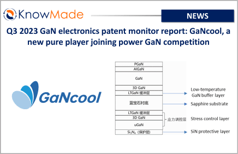
GaNcool focuses on the development and production of GaN wafers intended to produce integrated circuits. It claims to have reached the status of mass production for GaN-on-Si wafers, and to have on-going developments for GaN-on-sapphire and GaN-on-SiC platforms. When GaN is grown on foreign substrates, the mismatches in lattice constants and thermal expansion coefficients lead to high defect density, deformation, wrapping or even cracks. This prevents the use of these substrates in high power applications. To overcome this bottleneck, GaNcool provides a method of using double-sided growth technology on sapphire substrates. As claimed in the patent application CN116544194 published in Q3 2023, the GaN epitaxial layer is grown on the front side of the substrate, and stress control layer followed by a SiN protective layer are prefabricated on the back side of the substrates (Figure 2). The stress control layer includes a low-temperature GaN buffer layer, a 3D GaN layer and an undoped GaN layer, in which the thickness of the undoped GaN layer is tuned to compensate for the tensile stress created by the GaN epitaxial layer. According to the inventors, the wrapping degree is significantly reduced, providing crack-free epilayers for the fabrication of high-power devices.

Illustration of GaNcool’s GaN-on-sapphire double-sided growth technology as claimed in the patent CN116544194.

Figure 2: Schematic diagram of double-sided growth technology of GaN-on-sapphire adapted from GaNcool’s patent application CN116544194.

Although the lateral GaN-on-Si devices have gained a great space in power applications, their markets are still limited to the low voltage range (650 V and under). Vertical GaN devices are proposed to overcome the voltage limitations of the lateral devices. To expand its IP strategy to high voltage applications, GaNcool has developed some methods for the fabrication of vertical GaN devices, with four new patent publications identified in Q3 2023. These inventions provide technical solutions to overcome i) poor activation of the p-GaN layer (CN116705607), ii) surface damage at the bottom and the side wall of the gate trench caused by etching (CN116544105), iii) early breakdown due to current crowding (CN116741810), iv) GaN etching or decomposition during cooling down and the introduction of impurities to the GaN surface during device processing (CN116825619).

Illustration of GaNcool’s GaN-on-sapphire double-sided growth technology as claimed in the patent CN116544194.

Figure 3: (a), (b), (c), (d) Schematic diagrams of the vertical GaN structures adapted from GaNcool patent applications CN116705607, CN116544105, CN116741810, CN116825619, respectively.

In the conventional vertical GaN device, high p-doped GaN is still difficult to achieve due to poor activation of the p-GaN layer. In the patent application CN116705607, GaNcool uses a SiO2 or SiN mask to form a deposition groove on the n-GaN top layer (Figure 3 (a)). Then a trapezoid-shaped p-GaN layer is grown into the deposition groove with a height higher than the mask layer. After N-ions are implanted into the surface of the p-GaN layer, the ions are activated through an annealing process. It is well known that the Mg-doped p-GaN grown by MOCVD is usually activated by annealing the sample with gases to break the strong Mg-H bonding and activate the Mg acceptor. In conventional structures, the p-GaN layer is generally covered by epitaxial layers (cap layers, for example), that prevent the action of the annealing to break the Mg-H bonding. In this invention, the trapezoid-shaped increases the surface contact area of the p-GaN layer with the annealing gases, thereby promoting the activation process.

For vertical GaN power transistors, the gate trench is generally formed by plasma etching which introduces additional surface damage at the bottom and side walls of the groove. That will cause an increase in interface defects, abnormal electrical performance, and problems with the instability and reliability of the gate. To solve the damage caused by dry etching, GaNcool’s inventors developed an etching process using synchronous growth in the MOCVD (CN116544105). In this invention, after patterning the SiO2 to reveal the GaN surface, the wafer is transferred into the MOCVD, where it is exposed to the H2, NH3, and trimethyl gallium (TMG) gases. The gas flows of H2 and TMG are controlled to have GaN etching and growth at the same time, in which the etching rate is greater than the growth rate. This method provides a gate trench with minimized surface damage. Then a p-GaN layer can be grown into the groove, as shown in Figure 3 (b). Using this technique, after etching, the wafer is not taken out of the MOCVD, and groove surface treatment is directly carried out in the MOCVD. So, besides providing a groove with a smooth surface, the method also prevents the introduction of impurities and additional oxidation of the interface, caused by the exposure of the wafer to the air.

Using the etching process claimed in the patent application CN116544105, GaNcool then develops a method to grow an p-GaN/n+-GaN heterostructure into the groove with a larger interface (CN116741810). In this invention, after the groove is formed by the etching process in the MOCVD reactor, a p-GaN layer is grown on the periphery of the groove with a mushroom head structure. Then, a n+ GaN layer with a trapezoid shape is grown on top of the p-GaN layer (Figure 3(c)). This method can increase the interface between p-GaN and n+-GaN layers, leading to an increase in current spreading and limiting the occurrence of current breakdown in GaN electronic devices based on this structure.

Furthermore, GaNcool disclosed the growth of an in-situ SiN passivation mask on top of a vertical GaN structure (CN116825619). Different from the three other inventions where the SiO2 or SiN masks are deposited by using PECVD, in this invention the SiN passivation mask is formed directly on top of the n-GaN layer after the heterostructure is grown in the MOCVD reactor (Figure 3 (d)). The advantage pertained to this invention is that the GaN surface is protected by the SiN mask from any etching or decomposition when the temperature is reduced. The SiN mask also prevents the introduction of impurities on the GaN surface during the device processing. Additionally, the SiN mask and the GaN layer have good matching performance, so the problems of cracking caused by differences in thermal expansion can also be avoided.

A patent monitoring service to help you track competitors’ IP activity and detect weak signals

The GaN Electronics Patent Monitor provides up-to-date data on patent activity for RF & Power electronics. This monitoring service allows you to take advantage of a quarterly-updated Excel database and benefit from both quarterly analysis reports and direct access to our analysts for on-demand discussions regarding the results, trends, specific patented technologies, or companies’ patent portfolios in the field of GaN electronics.

The GaN Electronics Quarterly Patent Monitor can be subscribed to at any time directly from here. If you need more information, reach us at contact@knowmade.fr or with our contact forms.


Press contact
contact@knowmade.fr
Le Drakkar, 2405 route des Dolines, 06560 Sophia Antipolis, France
www.knowmade.com

About the author
Huong NGO, PhD., works at KnowMade as a Patent Analyst in the field of Compound Semiconductors and Optoelectronics. She holds a PhD in Physics from the University of Montpellier (France). Huong previously worked at Meijo University (Japan), CRHEA-CNRS (France), and Lafayette Institute (France) as Research Engineer.

About KnowMade
KnowMade is a Technology Intelligence and IP Strategy consulting company specialized in analyzing patents and scientific publications. The company helps innovative companies, investors, and R&D organizations to understand their competitive landscape, follow technological evolutions, reduce uncertainties, and identify opportunities and risks in terms of technology and intellectual property.
KnowMade’s analysts combine their strong technology expertise and in-depth knowledge of patents with powerful analytics tools and methodologies to turn patent information and scientific literature into actionable insights, providing high added value reports for decision makers working in R&D, innovation strategy, intellectual property, and marketing. Our experts provide prior art search, patent landscape analysis, freedom-to-operate analysis, IP due diligence, and monitoring services.
KnowMade has a solid expertise in Compound Semiconductors, Power Electronics, Batteries, RF Technologies & Wireless Communications, Solid-State Lighting & Display, Photonics, Memories, MEMS & Sensors, Semiconductor Packaging, Medical Devices, Medical Imaging, Microfluidics, Biotechnology, Pharmaceutics, and Agri-Food.

October 27, 2023

October 2023 GaN newsletter: Qromis Substrate Technology (QST) for power GaN and RF GaN devices

SOPHIA ANTIPOLIS, France – October 27, 2023 │The GaN newsletter for October 2023 is now available! This monthly newsletter allows you to keep up to date on the latest scientific publications, patent applications, and news related to III-Nitride semiconductors (GaN, AlN, InN, and alloys) for optoelectronic and electronic applications (power, RF, LED, laser, photonics, and so on).

This month, let us highlight the latest developments related to QST substrate technology for power GaN and RF GaN devices.

Qromis’ QST engineered substrate for GaN power electronics.

During heteroepitaxy, the lattice-constant and thermal-expansion-coefficient (CTE) mismatch between the epitaxial layer and the substrate results in the generation of defects either during growth or during cooling from growth temperature to room temperature. Qromis Substrate Technology (QST) solves the limitations of CTE mismatch by employing a core wafer CTE and presenting a Si (111) surface for GaN epitaxy. The CTE-matched core is made of poly-AlN ceramic and is surrounded by several dielectric layers (Thermal Management of Gallium Nitride Electronics, Woodhead Publishing P. 251-274). Following that, another dielectric layer is produced to create a smooth surface on which a (111)-oriented Si layer is bonded. This Si surface is epi-ready, which allows the application of well-developed GaN-on-Si technology to grow thick GaN layers, which is essential for the manufacture of high-performance GaN power electronics.

Image of the structure of QST engineered substrate provided by Qromis

Figure 1: The structure of QST engineered substrate (source: Qromis)

IMEC and Aixtron report 8.5 µm-thick GaN layers on 200 mm QST substrate.

In the latest scientific publication section of our GaN newsletter, we noticed that IMEC and AIXTRON research teams have successfully grown 5 µm GaN drift layers on 200-mm QST wafers in an AIXTRON G5+ C Planetary Reactor (5 x200 mm standard configuration). Optimized growth conditions result in GaN epitaxial layers that have low defect density and great uniformity, with total thicknesses of up to 8.5 µm. Using this structure, a semi-vertical diode with a breakdown voltage of 750 V is achieved. The growth of a high-quality thick GaN layer on the QST substrate enables higher breakdown voltages and better thermal management, making it a promising solution for vertical power devices.

Picture of Cross-sectional SEM of GaN epitaxial layers grown on a QST substrate and graphic showing Back-to-back diodes reverse leakage and breakdown

Figure 2: (a) Cross-sectional SEM of GaN epitaxial layers grown on a QST substrate and (b) Back-to-back diodes reverse leakage and breakdown. (source: W Gonçalez Filho et. al., Sci Rep 13, 15931 (2023))

Shin-Etsu’s QST platform for power GaN and RF GaN markets

One of the notable press releases in this month’s GaN newsletter is that Shin-Etsu, a worldwide chemical company, announced its market entry strategy for GaN power devices. Besides the sales of QST substrates, Shin-Etsu Chemical will also provide GaN-on-QST wafers with diameters of 6 inches and 8 inches (wafers of 12-inch diameter are in development). In addition, the company also developed a technology that enables the growth of a 20 μm-thick GaN layer and facilitates the achievement of power devices with a breakdown voltage of 1800 V. Furthermore, Shin-Etsu Chemical cooperated with Oki Electric and succeeded in developing a method that allows the exfoliation of a thick layer of high-quality GaN from an insulating QST substrate and bonding it to other substrates. This method paves the way for the fabrication of high-power, high-quality vertical devices on 200-mm substrates. This will promote the manufacture of power devices with high yields and competitive pricing.

To support its market strategy, Shin-Etsu took a license on QST technology from Qromis while filing several patents related to this innovative technology. Although Shin-Etsu’s recent press release focuses on the power GaN market, its recent patenting activity indicates that the company also started advancing the QST platform for RF applications, anticipating new opportunities in the emerging RF GaN market. In this month’s GaN newsletter, we report Shin-Etsu’s new patent application WO2023/176185 which aims to improve the thermal conductivity and the mechanical strength of QST substrates. For that purpose, the inventors make possible the bonding of a modified type of AlN ceramic core (including fiber-like AlN single crystal) to a Si<111> seed layer via a flat sealing layer and a planarization layer. As a result, the thermal conductivity can be increased from 170 W/mK (upper limit of polycrystalline AlN ceramics) to 200 W/mK for AlN ceramics in which monocrystalline AlN fibers are introduced. Likewise, the fracture toughness of the AlN ceramic core can be improved from 3 MPa.m1/2 to 10 Mpa.m.1/2. What’s more the warping issue is alleviated, which may translate into a higher yield and lower cost for such epiwafers. These improvements promote the GaN-on-QST platform in demanding applications such as automotive applications and RF applications where thermal management remains critical. Especially, this new QST platform can be optimized to reduce high-frequency losses, by introducing a high-resistivity Si<111> seed layer (> 1 kΩ.cm), as claimed by Shin Etsu’s inventors in this new patent application.

Image from patent application WO2023176185

Figure 3: Adapted drawing from Shin-Etsu’s patent application WO2023/176185

Vanguard International Semiconductor QST related patent activity

Another company, Vanguard International Semiconductor (VIS), a Taiwanese leader in IC foundry, also got the license from Qromis for QST technology in 2018. In previous months, VIS published a new patent application related to GaN-on-QST for power applications (US20230170389). The invention aims to prevent the Si seed layer from generating a back gating effect in the GaN HEMT and is applicable to GaN-on-QST or GaN-on-SOI platforms. In the October 2023 GaN newsletter, we report a new patent application from VIS related to QST substrates (US20230299146). The invention describes a superlattice buffer structure that prevents warpage and stabilizes the curvature of GaN epiwafers based on Si, SOI and QST substrates, on a wide range of thicknesses. According to VIS’ inventors, this structure is particularly suitable for high-power RF GaN-HEMTs, where a superlattice layer with thinner thickness and small bow variation is usually required to improve RF characteristics.

A GaN newsletter to help you make your way in various dynamic competitive landscapes

With the monthly GaN newsletter, KnowMade provides a cost-efficient way to access the different players’ recent R&D activities and latest collaborations, to have a complete picture of their strategies to enter the market at the right time, with the right products, and to detect new players worldwide early on. Combining both patent and paper analyses provides answers to many questions you might have about the players in your ecosystem. In the end, the GaN newsletter is also about detecting timely new threats and opportunities for your activities. As such, the GaN newsletter is valuable for researchers, engineers, and IP professionals, but it is also a powerful tool in the hands of marketing and innovation strategists and commercial teams.

The GaN newsletter can be subscribed to at any time directly from here. For more information about the GaN newsletter, please contact us at contact@knowmade.fr.


Press contact
contact@knowmade.fr
Le Drakkar, 2405 route des Dolines, 06560 Sophia Antipolis, France
www.knowmade.com

About the author
Rémi Comyn, PhD., works at KnowMade as a Patent Analyst in the field of Compound Semiconductors and Electronics. He holds a PhD in Physics from the University of Nice Sophia-Antipolis (France) in partnership with CRHEA-CNRS (Sophia-Antipolis, France) and the University of Sherbrooke (Québec, Canada). Rémi previously worked in compound semiconductors research laboratory as Research Engineer.
Huong NGO, PhD., works at KnowMade as a Patent Analyst in the field of Compound Semiconductors and Optoelectronics. She holds a PhD in Physics from the University of Montpellier (France). Huong previously worked at Meijo University (Japan), CRHEA-CNRS (France), and Lafayette Institute (France) as Research Engineer.

About KnowMade
KnowMade is a Technology Intelligence and IP Strategy consulting company specialized in analyzing patents and scientific publications. The company helps innovative companies, investors, and R&D organizations to understand their competitive landscape, follow technological evolutions, reduce uncertainties, and identify opportunities and risks in terms of technology and intellectual property.
KnowMade’s analysts combine their strong technology expertise and in-depth knowledge of patents with powerful analytics tools and methodologies to turn patent information and scientific literature into actionable insights, providing high added value reports for decision makers working in R&D, innovation strategy, intellectual property, and marketing. Our experts provide prior art search, patent landscape analysis, freedom-to-operate analysis, IP due diligence, and monitoring services.
KnowMade has a solid expertise in Compound Semiconductors, Power Electronics, Batteries, RF Technologies & Wireless Communications, Solid-State Lighting & Display, Photonics, Memories, MEMS & Sensors, Semiconductor Packaging, Medical Devices, Medical Imaging, Microfluidics, Biotechnology, Pharmaceutics, and Agri-Food.