August 25, 2022

KnowMade’s expertise in Energy storage and management

The next decade will be marked by the decarbonisation of our society to achieve carbon neutral status, i.e., net-zero carbon dioxide (CO2) and other greenhouse gas emissions. With the accelerating shift towards electric vehicles and the growing integration of renewables into our energy system, an increasingly more significant portion of our everyday life will depend on reliable energy storage and management technologies.
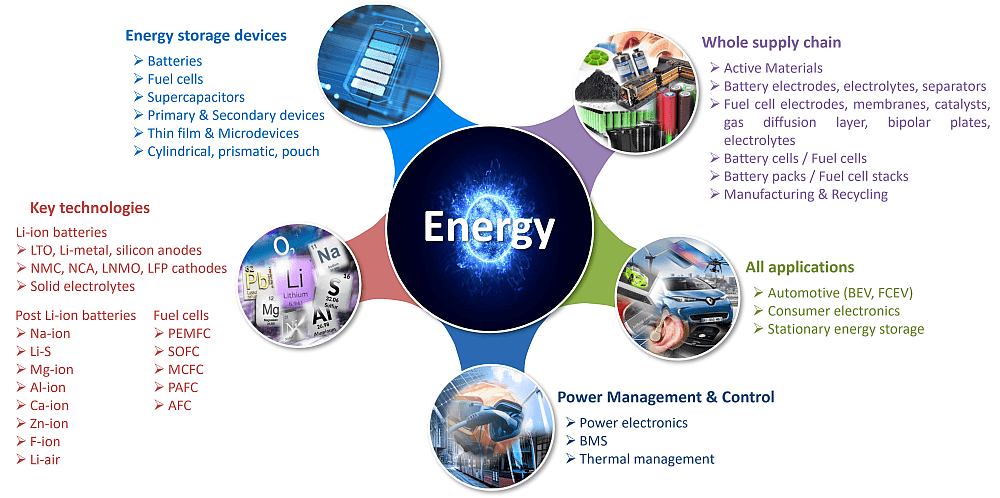
Energy storage technology expertise.

Electrification of the transportation industry is driving energy storage and management technologies

The transportation sector is undergoing major transformations to fulfil new fuel economy regulations and CO2 emission reduction targets from various governments. Battery electric vehicles (BEV) and hydrogen fuel cell electric vehicles (FCEV) are considered to replace current fossil-fuelled internal combustion-engine vehicles (ICEVs). The technological developments of batteries and fuel cells are driven by this transition. Hydrogen fuel cells and electric batteries are often portrayed as competing technologies (proton versus electron), but they should play complementary roles to decarbonise transportation.

Battery electric vehicles are achieving momentum, and most automakers are now committed to moving from ICEVs to BEVs in a decade. This transition creates opportunities and risks in a highly competitive battery industry where improvements and new technology developments are being made at all levels of the value chain. With some unresolved issues for electric vehicles (mileage autonomy and charging speed, to name a few), we are witnessing a revival in interest in fuel cell technology for electric transportation. Hydrogen fuel-cell passenger cars are a niche product and will likely remain insignificant in the coming years. Fuel-cell technology will fare better for long-haul freight transport. Although fuel cell is an old technology, there is still a lot of room for improvement before hydrogen can play its part in the decarbonisation of the transportation sector. The move from internal combustion engines (ICE) to an all-electric power platform is supported by electric drive development, where wide bandgap semiconductors emerge as promising candidates to enable significant efficiency improvements in power management systems.

KnowMade’s experts have responses

At KnowMade, we have both battery technology expertise and fuel cell expertise to follow and analyse R&D developments and patent activities. We track current and future challenges, the latest innovations, and emerging technologies – from cell materials and components to cells and packs – all the way to energy management systems, safety, and recycling. We cover the leading application segments: consumer electronics, e-mobility, and stationary energy storage.


Latest reports on energy storage technologies
Featured image of the Li-ion battery CAM recycling patent landscape report 2025.
Who are the key players and newcomers in the global IP race for Li-ion batteries cathode active materials recycling? Publication September 2025 Download Flyer Download [...]
Who are the key players and newcomers in the global IP race for the promising silicon anode-based Li-ion batteries? Publication September 2024 Download Flyer Download Sample [...]
Featured image of the Halide solide electrolytes for li-ion batteries patent landscape report.
Patented technologies and nascent IP competition for emerging halide solid electrolyte materials Publication May 2024 Download Flyer Download Sample KEY FEATURES PDF >90 slides Excel [...]

Patent monitors on energy storage technologies
Featured image of the Silicon Anode Li-ion Batteries Patent Monitor.
Get up-to-date data on silicon anode Li-ion batteries patent activity: New patent applications, patents newly granted, expired or abandoned patents, latest patent transfers, patent litigations [...]
Get up-to-date data on Solid-State Battery patent activity: New patent applications, patents newly granted, expired or abandoned patents, latest patent transfers, patent litigations and oppositions [...]

Latest insights on energy storage technologies

Featured image of the article Decoding Stratus Materials’ technology at the heart of its partnership with Ampère.
SOPHIA ANTIPOLIS, France – 28 November, 2025 │ Technical insights and IP analysis of Stratus Materials’ LXMO™ breakthrough battery chemistry. In a strategic move to [...]
Featured image of the article Ascend Elements: a dynamic player in the competitive space of Li-ion battery recycling.
SOPHIA ANTIPOLIS, France – November 19, 2025 │ The lithium-ion battery (LIB) recycling landscape is currently in its developing stage, shifting from research phase to [...]
Featured image of the article Tulip Innovation vs. Sunwoda Highlights IP Enforcement Surge in Europe.
SOPHIA ANTIPOLIS, France – September 01, 2025 │ As Europe accelerates its battery ambitions, a new wave of litigation is emerging, where patents are becoming [...]

November 28, 2025

Decoding Stratus Materials’ technology at the heart of its partnership with Ampère

SOPHIA ANTIPOLIS, France – 28 November, 2025 │ Technical insights and IP analysis of Stratus Materials’ LXMO™ breakthrough battery chemistry.

In a strategic move to advance next-generation battery technologies, Ampère, the electric-vehicle and software-dedicated subsidiary of Renault Group, has entered into a Joint Development Agreement (JDA) with Stratus Materials, a US-based innovator in cobalt-free cathode materials (read more). Under the agreement, Stratus’s proprietary LXMO™ (Lithium Nickel Manganese Oxide) cathode active material will be evaluated in EV-format battery cells at Ampère’s newly inaugurated Battery Cell Innovation Lab in Lardy, France. The collaboration reflects Ampère’s three-phase battery strategy, initially leveraging NMC (nickel-manganese-cobalt) chemistries, then LFP (lithium-iron-phosphate) from 2026, and now advancing toward high-energy, cobalt-free materials aimed at combining high energy density with lower cost, improved safety, and reduced reliance on critical raw-material supply chains.

Stratus Materials: A rapidly scaling startup on high-energy cathode materials

Stratus Materials Inc., headquartered in Pittsburgh, Pennsylvania (United States), was founded in early 2022 (formerly operating as 33 Tech Inc.) and positions itself in the battery value chain as a material manufacturer focused on advanced cathode active materials (CAM) for lithium-ion batteries (www.stratusmaterials.com). The company develops manganese-rich, cobalt-free “LXMO” / LMR cathodes intended for light- and medium-duty electric vehicles (EV) and energy storage applications. As a startup venture-backed pure-play, Stratus Materials has raised approximately US $15–29 million in its seed/Series A funding round, notably with participation from Breakthrough Energy Ventures and DNS Capital. It is currently building a pilot production line targeting approximately 30 tons per year of CAM capacity, and in August 2025 announced that it had begun shipping its second-generation LXMO-2 material to customers and partners. In July 2024, multiple outlets report that LXMO-based pouch cells surpassed 1,000 full depth-of-discharge cycles while retaining >80% of initial capacity, using standard graphite anode and conventional electrolyte (read more).

In this context, understanding the company’s intellectual property strategy becomes essential to evaluate its positioning and long-term competitiveness. Moreover, a closer look at Stratus Materials’ patent portfolio offers valuable insight into their underlying cobalt-free cathode technology.”, explains Fleur Thissandier, PhD, Senior Technology and Patent Analyst at KnowMade.

Stratus Materials holds a recent but global patent portfolio

Stratus Materials began its patent filings as soon as it was founded in 2022-2023, demonstrating the company’s significant innovation efforts and its intention to secure its technology. To date, Stratus Materials holds six patent families, comprising 31 individual patent applications (none granted yet, with 29 applications still pending). The company pursues a global IP strategy, extending its patent protection across multiple countries, not only in major regions such as the United States, Europe, China, Japan, and Korea, but also in India, Canada, Australia, Brazil, and Taiwan.

Bar chart showing the Straus Materials' patent activity by publication countries.

Figure 1: Current legal status and geographical distribution of patents held by Stratus Materials.

Stratus’ patented technology: Doping, Microwave & Ultra-Rapid Quenching

Stratus Materials’ patent portfolio covers several specific high-energy density lithium-rich metal oxide (LRMO) cathode materials, often designed to be cobalt-free. These include layered lithium-rich nickel manganese oxides, represented by the formula Li[NixLi(1/3−2x/3)Mn(2/3−x/3)]O2, where 0<x<0.5 (patent application US20230015455). A subset of these patents focuses on materials characterized by the formula Lix(MnyNi1−y)2−xO2, where x is >1.05 and <1.25, and y ranges from 0.1 to 0.95 (US20250145493, US20230227327, EP4460854). Furthermore, patent applications US20240262709 and US20250145493 introduce substituted lithium-rich metal oxide (S-LRMO) materials, defined by Li[LixAyMz]Ob, where A comprises Na, K, Ca, or Mg at substitution levels exceeding conventional doping (y>0.05).

Graphic abstracted from a Stratus Materials' patent.

Figure 2: XRD patterns of pristine layered lithium rich nickel manganese oxide (LLRNMO) powders patented by Stratus Materials, extracted from US20230015455.

Stratus Materials’ patent portfolio focuses on advanced synthetic routes for high-energy density lithium-rich metal oxide (LRMO) cathode materials, specifically addressing the critical issue of structural instability induced by slow cooling. The unifying core methodology across these inventions is the implementation of ultra-rapid quenching (URQ), which involves arresting the material structure by cooling the sintered powder from high temperatures (typically ≥800C) to a low quenching temperature (≤120C or room temperature) in less than 500 milliseconds, achieving cooling rates of at least 1750C/second. This rapid thermal processing is crucial to prevent undesirable changes to the crystal structure, such as oxygen losses and transition metal ion migration, which commonly degrade LRMO performance. Synthesis methods are refined through specialized engineering (US20240353178), such as using a tilted rotary furnace combined with a quick transfer conduit to ensure the powder remains hot (within 200C of the sintering temperature) before hitting the quench fluid (e.g., water, potentially with additives like acids or carbohydrates). Alternative precursor formation techniques enhance homogeneity: precursors may be thermally decomposed using microwave radiation before sintering (US20230227327, EP4460854, US20240262709), which provides efficient volumetric heating, or by aerosolizing a precursor composition at 500C to 900C (US20250145493), a technique that also permits the recycling of gaseous species to improve efficiency and reduce chemical waste.

Visualization of the manufacturing process patented by Stratus Materials.

Figure 3: Overview of LRMO manufacturing methods patented by Stratus Materials.

The patented materials demonstrate superior electrochemical performance and stability. Key advantages include materials exhibiting high specific capacity, such as at least 230 mAh/g after 50 cycles, and S-LRMO materials capable of over 200 mAh/g (C/20 rate). Crucially, the URQ process stabilizes the materials, leading to excellent durability, evidenced by less than 10% capacity fade over 100 C/5 cycles, or even less than 5% capacity fade over 200 C/4 cycles, and low voltage decay (less than 10% loss in average discharge voltage after 100 or 200 cycles). These characteristics indicate that ultra-rapid quenching (URQ) effectively locks in the desired layered hexagonal and monoclinic crystal phases, stabilizing high-energy structures for practical battery applications.

Graph abstracted from a Status Materials' patent.

Figure 4: Plots showing long term (320 cycles) cycle stability of sodium substituted S-LRMO material (Li1.081Na0.057 Mn0.652Ni0.21O2) patented by Stratus Materials, extracted from US20240262709.

LRMO: A complex but promising rival to LMFP for future Li-ion batteries

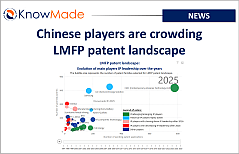
Lithium-rich metal oxide (LRMO) cathodes are emerging as a leading next-generation option thanks to their high specific capacities (≈250 mAh.g⁻¹) enabled by combined cationic and anionic redox, offering high energy density at lower material cost. Despite this promise, LRMOs face crucial commercial challenges, specifically low initial Coulombic efficiency (ICE), poor rate capability, and rapid capacity and voltage decay, originating from irreversible structural degradation, lattice oxygen loss, transition metal migration and dissolution, and harmful interfacial side reactions triggered by high charging voltages. In contrast, LMFP, another cathode material envisioned for next generation of Li-ion batteries, is already scaling industrially. LMFP represents an incremental evolution of LFP through the incorporation of manganese to raise operating voltage and boost energy density by roughly 10-20%. LMFP retains the olivine structure, offering excellent thermal stability, long cycle life, and low cost, but its performance remains fundamentally constrained by the polyanionic framework, limiting practical energy density to intermediate levels suitable for mid-range EVs. Thus, LMFP offers near-term, cost-effective performance gains over LFP, while LRMO represents a high potential but technologically more complex long-term pathway for advanced EV batteries.

In this thriving context, KnowMade publishes in-depth reports and provides monitoring services to track and analyze competitors’ R&D and intellectual property strategies. These insights help identify the focus areas of industry leaders, emerging players, and start-ups, offering an early perspective on their strategic direction, technological investments, and product development efforts.


Press contact
contact@knowmade.fr
Le Drakkar, 2405 route des Dolines, 06560 Valbonne Sophia Antipolis, France
www.knowmade.com

About the author
Fleur Thissandier, PhD, works as Senior patent and technology analyst at KnowMade in the field of Materials Chemistry and Energy storage. She holds a PhD in Materials Chemistry and Electrochemistry from CEA/INAC, (Grenoble, France). She also holds a Chemistry Engineering Degree from the Superior National School of Chemistry (ENSCM Montpellier, France). Fleur previously worked in battery industry as R&D Engineer.

About KnowMade
KnowMade is a technology intelligence and IP strategy firm specializing in the analysis of patents and scientific publications. We assist innovative companies, investors, and research organizations in understanding the competitive landscape, anticipating technological trends, identifying opportunities and risks, improving their R&D, and shaping effective IP strategies.
KnowMade’s analysts combine their strong technology expertise and in-depth knowledge of patents with powerful analytics tools and methodologies to transform patent and scientific data into actionable insights to support decision-making in R&D, innovation, investment, and intellectual property.
KnowMade has solid expertise in Semiconductors and Packaging, Power Electronics, Batteries and Energy Management, RF and Wireless Communications, Photonics, MEMS, Sensing and Imaging, Medical Devices, Biotechnology, Pharmaceuticals, and Agri-Food.

November 19, 2025

Ascend Elements: a dynamic player in the competitive space of Li-ion battery recycling

SOPHIA ANTIPOLIS, France – November 19, 2025 │ The lithium-ion battery (LIB) recycling landscape is currently in its developing stage, shifting from research phase to industrial demonstration and full supply chain integration. What seemed once a complementary approach to material supply from international partners has rapidly acquired the status of strategic interest for a whole industrial ecosystem, with governments and OEMs prioritizing local supply, traceability, and circularity. This transition touches every tier of the value chain: upstream, midstream and, increasingly, end‑of‑life management through recycling and re‑manufacture.

The policy environment has accelerated the shift. Circular‑economy mandates and recycled‑content requirements are reshaping procurement criteria, pushing companies to deliver domestically sourced materials with robust data on provenance and emissions. At the same time, the global battery industry has seen a seemingly sudden but long brewed policy shifts, from US tariffs to Chinese technology and materials export blockades and all the cascade effect on Europe.

Whether sudden or not, LIB recycling moved from being part of the process to a strategically valuable stage in securing stable, efficient and equally profitable supply chain. The result is a race to secure materials feed while maintaining competitive costs and quality.

While the Chinese LIB industrial system is massively researching every possible aspect in the LIB manufacturing ecosystem, with many intellectual property (IP) players in the recycling field with global relevance [1], companies from other parts of the world did not stand still and fuelled the competition. “As highlighted in our recent report LIB Cathode Active Materials Recycling – Patent Landscape Analysis 2025, the IP competition across the globe is fierce, fast-paced and multi-faceted”, says KnowMade’s Technology Analyst Dr. Filippo Farina.

Over the next few years, as more factories ramp come into completion, Europe’s LIB recycling landscape will be defined by who can execute this integration fastest, turning geopolitical pressure into durable materials sovereignty without sacrificing economics or quality.

Efforts from European companies like Umicore, Cylib, Eramet & Suez, HydroVolt, Veolia, SNAM and Mecaware highlight European domestic advancements as a strategic tool, which comes nonetheless with the participation of other companies from overseas.

Ascend Elements: a rapid growth in the dynamic US landscape

The North American landscape comprises a whole ecosystem of LIB players, ranging from raw materials suppliers to battery manufacturers, OEMs, and recyclers. It is precisely in this latter segment that a U.S. company has built and secured its niche, while seeking to establish its influence overseas. Ascend Elements is a recycling company focused on Li-ion batteries, founded in 2015 as a spin-out of the Worcester Polytechnic Institute to develop commercially their research activities ongoing since 2011 to develop NMC recycling methods, and has been growing steadily ever since. After securing funding through multiple grants and investment rounds, its industrial activities were first implemented in their headquarters state of Massachusetts, before expanding to Michigan and Georgia from 2020 onward [2]. Recycling of Cathode Active Materials (CAM) is Ascend Elements’ core business, represented by the introduction of its Hydro-to-Cathode® technology for CAM precursors (pCAM) synthesis process. The company delivered its first commercial shipment of refined pCAM in the form of Lithium Carbonate (Li2CO3) in early 2025 [3], and its road to domestic success seems to be on the right path.

While establishing credibility in its home country, in recent years Ascend Elements’ view expanded overseas on European shores, finding a suitable environment in Poland. In this new context, Strategic Elemental Metals was more than keen to partner with a ramping company to establish a joint venture on Polish ground [4]. This agreement will strengthen Ascend Elements’ position beyond the US and mark its entry into foreign markets.

A focused IP portfolio

As an IP player in the field of LIB recycling, Ascend Elements devoted its focus to CAM treatment since its inception. Over time, additional activities in Graphite and Lithium precursors recycling and refining were explored. At present, Ascend Elements’ published patent portfolio comprises 35 patent families (inventions) grouping 119 individual patents, with its technological segmentation summarized as follows:

Bar chart showing the technology breakdown of Ascend Elements' patent portfolio.

Figure 1: Technological segmentation of current Ascend Elements’ patent portfolio (Note: a single patent family can be assigned to multiple segments).

As is evident, most of the intellectual property focuses on protecting CAM-related methods and processes, with a clear predominance of lithium ternary oxides. Most of patents have been published over the past 3 years, with a noticeable peak in 2024.

Bar chart showing the time evolution of Ascend Elements' patent publications.

Figure 2: Publications timeline of Ascend Elements’ patent families

Ascend Elements’ geographic strategy has been initially focused mainly over the USA, with successive patent publications in all major world locations. Up to today, the USA remain the main jurisdiction where patents are filed, followed by Europe, China and South Korea. The years 2023-24 saw the most IP activity, with over half of the total Ascend Elements’ patent publications, while 2025 saw patent filings only in the USA and PCT applications.

Map showing the geographical distribution of Ascend Elements' patent portfolio.

Figure 3: Geographical distribution of Ascend Elements’ granted patents and pending patent applications

The commercial expansion of Ascend Elements led to the creation of the joint venture AE Elements in partnership with Elemental Strategic Metals, which, is set to further develop the industrial capabilities of both companies in Europe, starting from Poland and already planning to build another facility in Germany [5]. This partnership enables the new entity to exploit the combined know-how of its parent companies; with Elemental Strategic Metals bringing extensive expertise in metals, the joint venture significantly broadens its technical capabilities. Its IP portfolio is composed by 4 patent families, currently regrouping patents filed in Poland only; their focus is mainly on the recovery of various active metals from LIB black mass (Li, Co, Mn, Ni) but also other elements present in the mix (Graphite, Cu, Fe, Al, F).

With its expertise in metal treatment and refining, Elemental Strategic Metals provides further expertise for the LIB recycling value chain in Europe.

Examples of Ascend Elements and partner’s IP portfolios

The IP portfolio under the name of Ascend Elements comprises several patents that have ignite interest from other patent applicants, as evidenced by the total number of citations. One patent family has been cited an impressive 232 times, while a handful of others have received up to 30 citations each. In this section, we present some examples of patents from Ascend Elements and Elemental Strategic Metals to provide the reader with a glimpse of the technological capabilities of these two players.

A key patent from Ascend Elements’ portfolio

Method and apparatus for recycling lithium-ion batteries – US10522884

The most cited patent family of the portfolio was initially filed by Worcester Polytechnic Institute and is today co-assigned to Ascend Elements. As an example of its content, here we will show the patent US10522884, first published in 2017 and then granted in 2020. Its patent family includes patents granted in USA and South Korea, and other pending patent applications in China, Japan and European jurisdictions, covering many of the most important market areas.

The patented invention discloses a method and an apparatus for LIB recycling, allowing to recover elements such as Co, Ni, Mn and Al at the same time (see figure).

Schematics abstracted from an Ascend Elements' patent.

Figure 4: Schematics of the invention in patent US10522884

The patent claims a solution method to isolate the key metals component of a Cathode Active Materials issued from black mass from recovered Li-ion batteries; there is no preferred cathode chemistry, although the method is particularly apt to recover metals commonly used in CAM such as NMC, NCA and LCO.

In this invention, after a preliminary leaching with Sulfuric Acid and Hydrogen Peroxide at mild temperatures to solubilise the metals, the addition of Sodium Hydroxide allows to precipitate metals hydroxides of Fe, Al, and Cu. The ratio of the metals remaining into the leached solution is then analysed and, if needed, supplemented with the lacking metals in their Sulphate form. After this stage, the pH is gradually increased using Sodium Hydroxide to recover the hydroxide form of NMC or NCA if Al is present; Lithium Carbonate is also isolated. After this step, the remaining hydroxide is calcined to obtain a pristine CAM ready to be reused in the cathode manufacturing process.

A less common target material for recycling companies in LIB

Recycled Graphite for Li-Ion Batteries – JP7649364

The invention is currently protected in Japan (granted patent JP7649364), but related patent family also regroups other patent applications currently awaiting approval in Europe, USA, South Korea, and China. The invention reports a method to recover Graphite from the black mass resulting from the crushing of Li- or Na-based batteries. After impurities removal, the material is treated in alkaline environment; after other washing steps, both neutral and acid, all active metals are isolated, and the Graphite can be extracted. A sintering step allows to refine the Graphite in high purity, ready to be reused in novel electrode manufacturing.

Schematics abstracted from an Ascend Elements' patent.

Figure 5: Schematics of the invention claimed in patent JP7649364

A patent from Elemental Strategic Metals’ portfolio

Method of carrying out the recovery process of cobalt, nickel and manganese(IV) oxide from electrolytes obtained as a result of leaching black mass recovered from used lithium-ion batteries – PL246860

The patent PL2146860 from Elemental Strategic Metals describes an electrochemical method to recover metals from a leaching solution from spent LIB black mass. The electroseparation process originates in the first step Co and Cu on the cathode and MnO2 on the anode; after a second step Ni is deposited on the cathode.

Steps of the process described in an Ascend Elements' patent.

Figure 6: Process described in patent PL2146860 (readapted image)

This method allows the precise recovery of key elements from spent LIB active materials. The expertise in metals electroseparation from Elemental Strategic Metals well complements the LIB recycling expertise from Ascend Elements, offering a wider range of choice and operational possibilities to their joint venture AE Elemental.

Conclusion

As the global lithium-ion battery industry races toward circularity, Ascend Elements stands out as a dynamic and strategically aligned player. Rooted in US innovation and now expanding into Europe, the company has successfully positioned itself as a credible player in LIB recycling.

From its US headquarters Ascend Elements’ strategic pivot into Europe through its joint venture with Elemental Strategic Metals underscores its global ambition. The establishment of AE Elemental in Poland, and planned capacity in Germany, show a clear commitment to localizing circular battery materials in a region racing to build strategic autonomy.

Intellectual property is another core asset. With over 100 patents spread across cathode materials, anodes, and lithium recovery technologies, Ascend Elements not only manufactures but also protects knowledge critical to next-generation supply chains. The high citation rate of some patent families highlights the relevance and technological impact of their innovation.

This IP approach gives Ascend Elements a competitive edge in a sector where traceability, performance, and regulatory alignment are no longer optional. As battery recycling transitions from waste management to value generation, companies are shaping what circularity means in the real world. The recent joint venture AE Elementals created with Elemental Strategic Metals marks a further step in Ascend Elements’ strategy in Europe, highlighting the full commitment to developing a fully functioning recycling ecosystem for LIBs.

In the coming years, much will depend on the execution: facility ramp-ups, feedstock sourcing, offtake agreements, and the evolution of international partnerships. But for now, Ascend Elements offers credibility and a good example of how strategic focus, IP leadership, and industrial deployment can build solid positions in the fast-evolving battery economy.

Sources:

1

https://www.knowmade.com/technology-news/energy-technology-news/batteries-news/mapping-the-european-patent-landscape-in-li-ion-batteries-the-strategic-positioning-of-brunp-in-recycling/

2

https://ascendelements.com/about-us/

3

https://www.idtechex.com/en/research-article/ascend-elements-offtake-agreement-for-lithium-carbonate/34014

4

https://ascendelements.com/ascend-elements-and-elemental-strategic-metals-establish-ae-elemental-an-electric-vehicle-battery-recycling-jv-in-poland/

5
https://www.electrichybridvehicletechnology.com/news/europes-newest-ev-battery-recycling-facility-opens-in-poland.html


Press contact
contact@knowmade.fr
Le Drakkar, 2405 route des Dolines, 06560 Valbonne Sophia Antipolis, France
www.knowmade.com

About the author
Filippo Farina, PhD. works at KnowMade as Patent & Technology Analyst in the field of Energy Storage and Conversion. He holds a PhD in Materials Chemistry from the University of Montpellier (France). After spending few years in industry (Morgan Avanced Materials, EcoLab), he has been working since 2015 on materials for batteries and fuel cells at University of Montpellier, CNRS and CEA-LITEN (France). Contact: filippo.farina@knowmade.fr .

About KnowMade
KnowMade is a technology intelligence and IP strategy firm specializing in the analysis of patents and scientific publications. We assist innovative companies, investors, and research organizations in understanding the competitive landscape, anticipating technological trends, identifying opportunities and risks, improving their R&D, and shaping effective IP strategies.
KnowMade’s analysts combine their strong technology expertise and in-depth knowledge of patents with powerful analytics tools and methodologies to transform patent and scientific data into actionable insights to support decision-making in R&D, innovation, investment, and intellectual property.
KnowMade has solid expertise in Semiconductors and Packaging, Power Electronics, Batteries and Energy Management, RF and Wireless Communications, Photonics, MEMS, Sensing and Imaging, Medical Devices, Biotechnology, Pharmaceuticals, and Agri-Food.

September 1, 2025

Tulip Innovation vs. Sunwoda Highlights IP Enforcement Surge in Europe

SOPHIA ANTIPOLIS, France – September 01, 2025 │ As Europe accelerates its battery ambitions, a new wave of litigation is emerging, where patents are becoming as critical as production lines.

Growing Momentum: Europe’s Battery Market Fuels Intellectual Property Enforcement

The electrification of transportation and the ramp-up of stationary energy storage have made Europe a strategic hub for the global battery industry. With numerous gigafactories under construction and strong policy support from the EU’s Green Deal and the Battery Regulation, the continent is fast becoming a critical center for lithium-ion cell development, production, and trade. This boom has not only brought commercial opportunity, but also a growing wave of litigation as companies seek to enforce their intellectual property (IP) rights. As technical differentiation becomes essential and supply chains diversify, IP portfolios are increasingly weaponized to defend market share and extract licensing value. One of the most prominent examples of this emerging trend is the legal confrontation between Tulip Innovation and Sunwoda in Germany, one that reflects the intensifying IP vigilance in the European battery space.

Tulip Innovation: A New IP Licensing Company in the Battery Arena

Tulip Innovation was established in May 2024, headquartered in Budapest, Hungary. The company positions itself as a licensing vehicle to enforce and monetize large portfolios of battery-related patents from LG Energy Solution (LGES) and Panasonic Energy. Tulip manages a portfolio of over 5,000 patents covering technologies such as battery separators, electrodes, electrolytes, and structural cell designs. As a non-practicing entity (NPE), Tulip does not manufacture battery components itself but acts on behalf of its licensors to enforce IP rights, particularly in Europe where the uptake of electric vehicles and green industrial policy is accelerating rapidly. Tulip‘s entrance into the IP battleground marks a shift toward more organized, aggressive licensing strategies in the battery sector.

Illustration showing the relationship between Tulip Innovation and Sunwoda over 3 patent litigation cases.

Figure 1: Overview of battery patent lawsuits in Germany between Tulip Innovation/LG Energy Solution and Sunwoda.

Tulip vs. Sunwoda in Germany: A Trilogy of Litigation

In 2025, Tulip Innovation initiated a coordinated series of patent infringement actions in Germany against Sunwoda, a Chinese battery manufacturer with growing presence in Europe. Sunwoda supplies batteries to major automakers, including Geely Auto, Renault Group, Nissan and Dongfeng Motor. All cases were filed before the Munich District Court, known for its IP expertise and relatively swift enforcement track record. The litigation concerns Sunwoda’s prismatic batteries, notably used in Renault Group’s electric vehicle Dacia Spring.

Action 1 & 2: May 22, 2025 — Dual Injunctions Over Separator Technology

In two parallel proceedings, the court granted infringement injunctions against Sunwoda over the German parts of the European patents EP1829139 and EP2528141. Both patents belong to the same patent family and cover an organic/inorganic composite microporous membrane coated separator and its use in Li-ion batteries. The ruling imposed an immediate sales ban, along with mandatory recall and destruction of infringing products, accounting obligations, and damages in principle. In response, Sunwoda filed nullity actions at the German Federal Patent Court. Preliminary opinions from the court indicate that both patents are likely to be upheld. Final decisions are expected by mid-2026.

The EP1829139, filed in December 2005, claims an organic/inorganic composite porous separator comprising a porous polyolefin-based substrate and a mixture of inorganic particles being electrochemically stable in a battery and a binder polymer having a glass transition temperature between -200°C and 200°C in a weight ratio of 60:40 to 99:1 coated directly on a surface of the substrate and a part of the pores present in the substrate. The electrochemically stable inorganic particles in the active layer are interconnected among themselves and are fixed by the binder polymer and permit interstitial volumes to be formed among them, and the interstitial volumes among the electrochemically stable inorganic particles form a pore structure that permits lithium ions to move therethrough. This separator has enhanced thermal safety, electrochemical safety, and lithium-ion conductivity. EP2528141, filed in 2012 as a divisional application to EP1829139, claims a lithium secondary battery comprising the separator claimed in EP1829139.

Abstract from concerned patents in the Tulip vs. Sunwoda litigation.

Figure 2: Images of organic/inorganic separators claimed in the patents EP1829139 and EP2528141.

Action 3: July 17, 2025 — Additional Injunction on Electrode-Separator Architecture

Tulip secured a third injunction on July 17, 2025, following a hearing on July 3, 2025, this time based on the German part of the European Patent EP2378595 related to advanced electrode-separator configurations used in prismatic EV cells.

EP2378595 claims an electrode assembly comprising a positive electrode with a non-coated portion, a negative electrode with a non-coated portion and a separator. The non-coating portions are disposed in at least one of the upper and lower portions of the electrode assembly in a longitudinal direction of the electrodes. A positive electrode tab and a negative electrode tab are connected to the non-coating portions. The separator is a complex porous separator including a substrate coated with a binder polymer or an organic/inorganic mixture formed of a binder polymer and inorganic particles. This configuration facilitates tab connections and its use as a high-power battery, improves the overall efficiency and safety of the battery and addresses issues related to short circuits and overcharging.

Illustration taken from a patent, the subject of a dispute between Tulip Innovation and Sunwoda.

Figure 3: Images of electrodes/separator assembly claimed in the patent EP2378595

This case resulted in another sales ban, product recall, destruction, and damages order against Sunwoda. A new nullity action was immediately initiated by Sunwoda. The German Federal Patent Court’s preliminary review again favored Tulip’s position, suggesting the patent may withstand the validity challenge.

Appeals Underway

Sunwoda has appealed to the May 22 decisions, and it is widely expected that the company will appeal the July 17 ruling as well. These appeals will proceed in parallel with the nullity proceedings, reflecting a comprehensive legal strategy to delay or overturn enforcement measures.

Outlook: More Litigation on the Horizon

The Tulip vs. Sunwoda saga is emblematic of a broader shift in the European technology landscape. As the EU continues to attract battery investment and expands local production capacity, enforcement of IP rights will likely become even more frequent. The impending rollout of the European Unitary Patent and the Unified Patent Court (UPC) is expected to further centralize and accelerate litigation across member states, offering both opportunities and risks for rights holders.

Companies with robust patent portfolios will be increasingly incentivized to use litigation as a tool to secure licensing revenue or block competitors. The Tulip cases may therefore serve as a harbinger of a much more litigious future for Europe’s clean technological markets. In this fast-paced and competitive landscape, gaining a deep understanding of the patent ecosystem and the strategies of various industry players is becoming increasingly crucial.”, concluded Dr. Fleur Thissandier, Senior Patent and Technology Analyst at KnowMade.

To address this need, KnowMade publishes in-depth reports and provides monitoring services to track and analyze competitors’ R&D and intellectual property strategies. These insights help identify the focus areas of industry leaders, emerging players, and start-ups, offering an early perspective on their strategic direction, technological investments, and product development efforts.


Press contact
contact@knowmade.fr
Le Drakkar, 2405 route des Dolines, 06560 Valbonne Sophia Antipolis, France
www.knowmade.com

About the author
Fleur Thissandier, PhD, works at KnowMade as Senior Analyst in the field of Materials Chemistry and Energy storage. She holds a PhD in Materials Chemistry and Electrochemistry from CEA/INAC, (Grenoble, France), and a Chemistry Engineering Degree from the Superior National School of Chemistry (ENSCM Montpellier, France). Fleur previously worked in battery industry as R&D Engineer.

About KnowMade
KnowMade is a technology intelligence and IP strategy consulting company specialized in analyzing patents and scientific publications. The company helps innovative companies, investors, and R&D organizations to understand the competitive landscape, follow technological evolutions, reduce uncertainties, and identify opportunities and risks in terms of technology and intellectual property.
KnowMade’s analysts combine their strong technology expertise and in-depth knowledge of patents with powerful analytics tools and methodologies to turn patent information and scientific literature into actionable insights, providing high added value reports for decision makers working in R&D, innovation strategy, intellectual property, and marketing. Our experts provide prior art search, patent landscape analysis, freedom-to-operate analysis, IP due diligence, and monitoring services.
KnowMade has a solid expertise in Compound Semiconductors, Power Electronics, Batteries, RF Technologies & Wireless Communications, Solid-State Lighting & Display, Photonics, Memories, MEMS & Sensors, Semiconductor Packaging, Medical Devices, Medical Imaging, Microfluidics, Biotechnology, Pharmaceutics, and Agri-Food.