
SOPHIA ANTIPOLIS, France – July 29, 2026 │ KnowMade’s latest quarterly analysis of silicon anode patent monitor is now available, providing an updated view of intellectual property (IP) activity in silicon-based negative electrode materials and related Li-ion battery technologies. More than 1,780 new patent publications were identified in Q2 2026, confirming sustained R&D activity around silicon-carbon composites, electrode architectures, pre-lithiation, manufacturing processes, and battery designs capable of accommodating silicon expansion.
China accounts for most newly published silicon anode patents
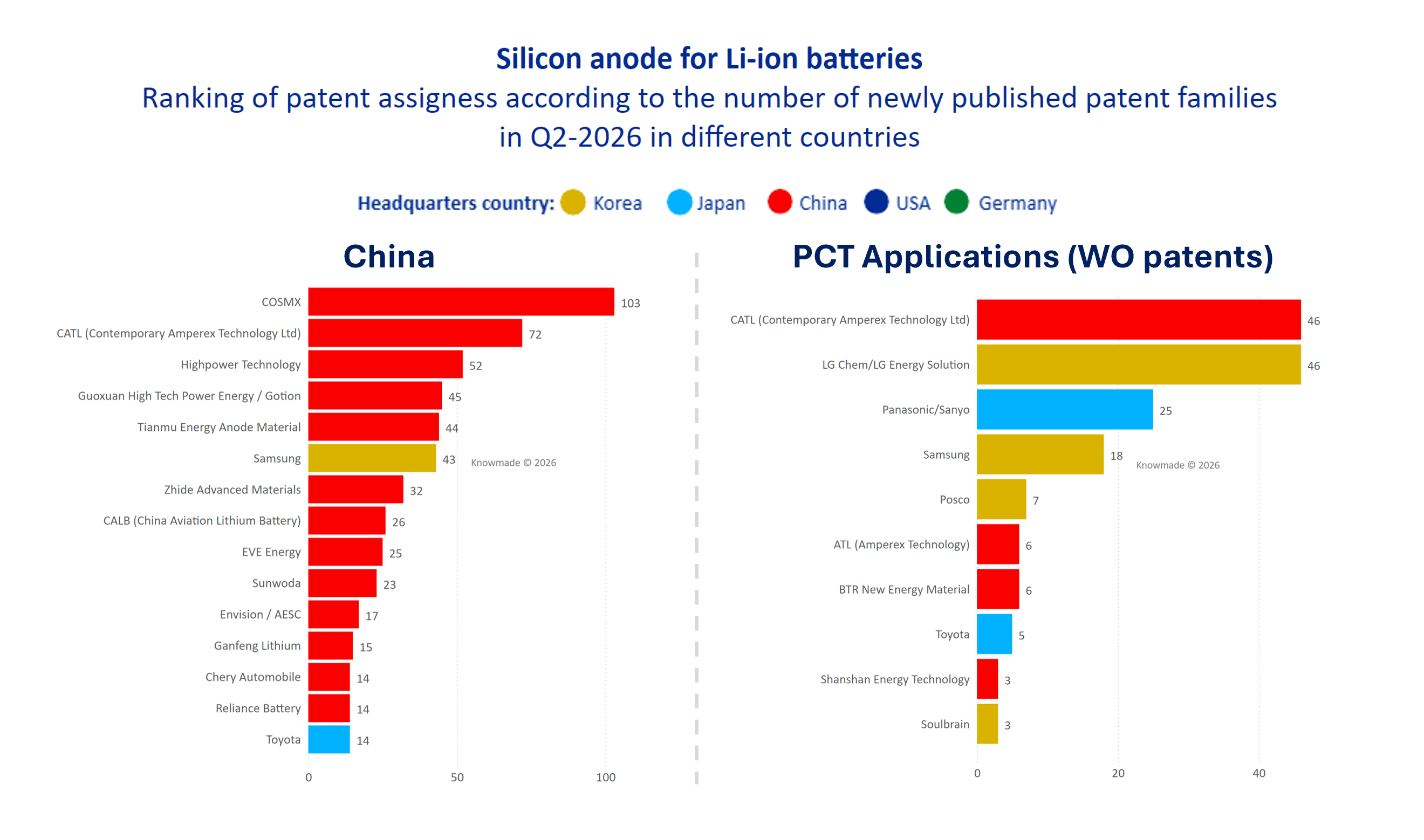
China accounted for 74% of the newly published patent families in Q2 2026, reflecting the scale of Chinese research and industrial development across silicon anode materials, electrodes, battery cells, and production processes. However, analysis by publication authority reveals marked differences between companies concentrating their patenting activity in their domestic markets and large international groups seeking protection across multiple regions.
Patenting activity in China is dominated by domestic IP players. Most Chinese applicants focus their protection primarily on the Chinese market, and only a limited number maintain extensive foreign patenting strategies. CATL, ATL, BTR, and Shanshan are notable exceptions, with patent families extended beyond China to address international markets.
Only two foreign companies, Samsung and Toyota, rank among the 15 leading applicants publishing in China. Their presence highlights the strategic importance of the Chinese battery market to established Korean and Japanese technology groups.
This domestic concentration contrasts with the profile of Patent Cooperation Treaty (PCT) applications. PCT patenting activity is led by major battery companies targeting worldwide markets, including CATL, LG, Panasonic, Samsung, POSCO, and ATL. These applicants use PCT applications to preserve opportunities for protection across several jurisdictions while evaluating the commercial and strategic importance of individual markets.
Source: Silicon Anode Patent Monitor Q2 2026
Regional patenting activity remains dominated by Asian companies
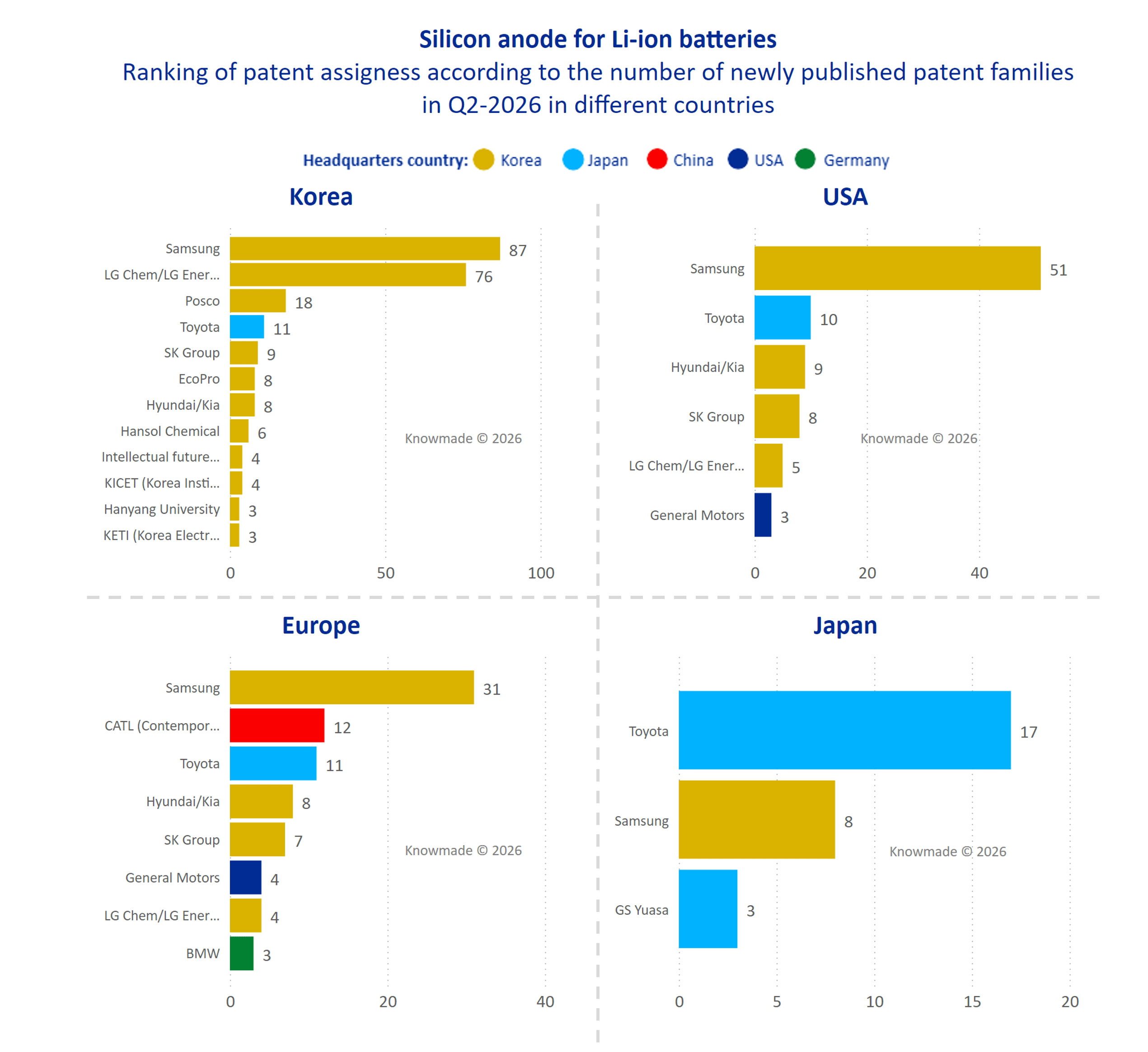
South Korean patent publications are primarily led by Korean industrial groups and research institutions. Major companies, including Samsung, LG, POSCO, SK, and EcoPro, are accompanied by active R&D organizations such as the Korea Institute of Ceramic Engineering and Technology, Hanyang University and the Korea Electronics Technology Institute. This combination of corporate and institutional research illustrates the depth of South Korea’s innovation ecosystem for silicon anodes.
In Japan, the leading silicon anode patent applicants include Toyota and GS Yuasa, alongside Samsung. Japanese activity therefore combines established domestic battery and automotive expertise with patent filings from a major Korean competitor.
The competitive landscape differs considerably in the United States and Europe. In both regions, patenting activity is dominated by foreign applicants. Samsung, Toyota, Hyundai, and SK are among the principal companies publishing in the United States. General Motors is the only American company represented among the main IP players across the principal publication countries examined.
In Europe, the leading applicants include Samsung, CATL, Toyota, Hyundai/Kia, SK Group, and LG. BMW is the only European company appearing among the principal IP players in these major publication jurisdictions.
Overall, the geographical analysis shows that Asian companies are not only generating most new silicon anode patents but are also taking leading positions in key international markets. Nevertheless, international filing strategies remain uneven: several Chinese companies maintain predominantly domestic portfolios, whereas major battery and automotive groups use PCT, US, and European filings to establish broader protection.
Source: Silicon Anode Patent Monitor Q2 2026
Main Q2-2026 IP players pursue different material and engineering strategies
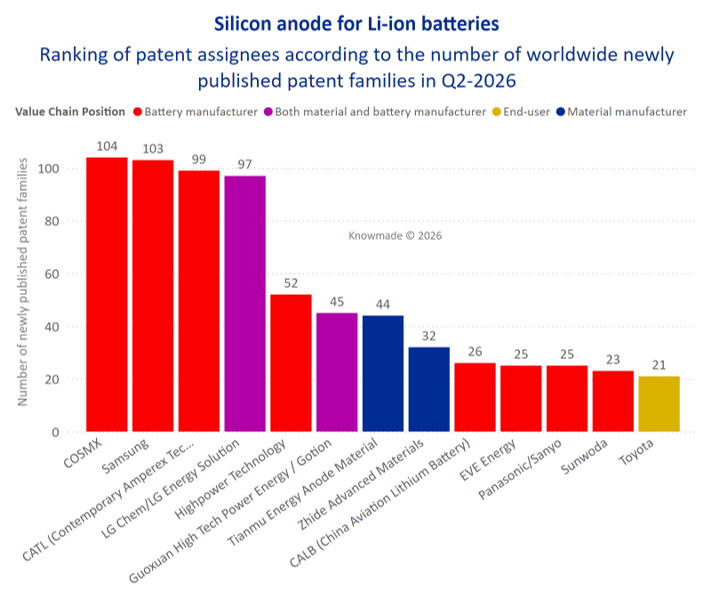
The quarter was led by COSMX, Samsung, CATL, LG Chem/LG Energy Solution, Highpower Technology, Gotion, and Tianmu Energy Anode Material. Most of the principal patent applicants are based in Asia, particularly China, South Korea, and Japan, and represent multiple parts of the battery value chain, including material suppliers, cell manufacturers, research organizations, and automotive end users.
Although applicants pursue different material and engineering strategies, the technical content of the Q2 2026 publications demonstrates a common industry priority: integrating greater quantities of silicon without allowing repeated volume changes to cause cracking, delamination, electrical disconnection, separator damage, or premature cell degradation. Several recurring approaches can be observed. These include hollow or porous silicon-carbon composites, protective surface coatings, multilayer electrodes, patterned electrode surfaces, conductive three-dimensional networks, controlled particle geometries, pre-lithiation, and redesigned internal cell structures.
Source: Silicon Anode Patent Monitor Q2 2026
COSMX develops hollow composites and mechanically adaptive cell designs
COSMX was one of the most active applicants in Q2 2026. Its patent activity emphasizes hollow silicon-carbon composite architectures containing internal cavities that provide space for silicon expansion.
The company is also developing patterned electrode surfaces with grooves and concave-convex structures. These physical features create additional buffer space while facilitating electrolyte access. Particle geometry is another important development area, with controlled sphericity and cross-sectional angles designed to reduce internal stress and limit the risk of separator puncture.
COSMX’s silicon anode patents also describe multilayer anodes that isolate silicon particles to preserve structural integrity and bonding strength. Porous diamond substrates and three-dimensional conductive networks are used to immobilize silicon and stabilize electrical pathways during cycling. Nitrogen doping and elemental chemical gradients are applied to improve conductivity and inhibit surface cracking.
Additional patents extend expansion management beyond the active material. Elastic protrusions and sponge-like layers within separators provide mechanical compression and buffering. Regional pre-lithiation techniques control lithium distribution across the electrode to prevent bending and improve initial efficiency. Nanoscale current collector coatings are intended to suppress metal precipitation, while optimized winding layouts use controlled gaps and component placement to balance internal cell pressure.
Samsung advances composite particles and dry silicon electrodes
Samsung SDI’s Q2 2026 silicon anode patents focus on high-capacity silicon-carbon composites and electrode structures capable of managing mechanical swelling.
Notable innovations include pipe-shaped silicon nanoparticles designed to reduce the consequences of volume variation during charging. Core-shell particles with protective carbon coatings improve structural integrity, while porous supports and mesoporous structures provide internal space for material expansion.
Samsung is also developing multilayered and patterned electrodes, dry-electrode manufacturing techniques adapted to silicon-based materials, and specialized slurry and coating processes intended to achieve uniform particle distribution. The integration of lithiophilic metal particles into silicon layers supports electronic and ionic transport.
Hybrid architectures combining silicon with different carbon allotropes are designed to maintain conductive pathways even as the electrode changes dimensions. Together, these technologies target increased energy density, faster charging, and longer cycle life.
CATL integrates silicon into porous carbon frameworks
CATL’s Q2 2026 patent activity prioritizes silicon-carbon composites in which silicon is incorporated into porous carbon structures. Hollow shells and internal pore channels are used to accommodate expansion and maintain structural stability.
The company’s filings also cover pre-lithiation, protective surface layers, and multilayer electrodes containing different silicon concentrations. By varying the composition across the electrode, CATL seeks to distribute mechanical stress more effectively.
Precision control over particle circularity and sphericity is intended to improve safety and fast-charging stability. Conductive networks preserve electrical contact during swelling, while optimized current collectors resist damage caused by repeated dimensional changes. Carbon and other protective coatings limit side reactions and material degradation.
Like COSMX and Samsung, CATL is developing patterned electrode surfaces with grooves and bulges that create physical expansion space. These approaches combine materials engineering and electrode design to improve capacity, safety, and cycling performance.
LG combines porous hosts, additives, and diagnostic systems
LG’s patents emphasize porous carbon frameworks derived from advanced metal-organic structures, providing hosts for silicon within composite anode materials. Surface doping and protective coatings are used to buffer expansion and stabilize silicon particles.
Multilayer electrodes with varying silicon concentrations distribute internal stress, while blends of different silicon materials and controlled particle geometries balance energy density and charging performance. Sacrificial additives compensate for lithium consumed during initial operation, helping to improve initial efficiency.
LG is also addressing industrial manufacturing challenges. Its patent applications describe slurry stabilizers intended to reduce gas generation and improve process reliability. Control of stiffness, hardness, and other mechanical properties helps preserve electrical conductivity as the electrode expands.
Hollow core assembly structures provide additional internal volume for swelling. Meanwhile, monitoring and diagnostic systems are designed to analyze silicon degradation and support longer battery service life.
Track silicon anode innovation with KnowMade’s Patent Monitor
The volume and technical diversity of Q2 2026 silicon anode patents make continuous competitive intelligence essential. Patent publications reveal not only which companies are increasing their activity, but also how they are positioning technologies across materials, electrodes, manufacturing processes, cell integration, and diagnostic systems.
KnowMade’s Silicon Anode for Li-ion Batteries Patent Monitor provides recurring access to newly published patent applications and supports the identification of key applicants, emerging technologies, portfolio developments, and geographical filing strategies.
By tracking patent activity quarter after quarter, R&D and IP teams can:
- Identify competitors developing similar silicon-carbon materials or electrode architectures.
- Detect changes in the patenting strategies of battery, material, and automotive companies.
- Compare domestic and international portfolio expansion.
- Monitor technical solutions for silicon expansion, conductivity, pre-lithiation, and manufacturing.
- Identify emerging collaboration, licensing, and technology-scouting opportunities.
- Anticipate potential IP risks and freedom-to-operate considerations.
The Q2 2026 results confirm that innovation is progressing simultaneously at the active material, composite, electrode, current collector, electrolyte, separator, and cell-design levels. With Chinese publications representing 74% of newly published patent families and Asian applicants leading activity across the main jurisdictions, structured patent monitoring provides an essential basis for understanding the evolving competitive environment surrounding next-generation silicon anodes.
Press contact
contact@knowmade.fr
Le Drakkar, 2405 route des Dolines, 06560 Valbonne Sophia Antipolis, France
www.knowmade.com
About the author
Fleur Thissandier, PhD, works as Senior patent and technology analyst at KnowMade in the field of Materials Chemistry and Energy storage. She holds a PhD in Materials Chemistry and Electrochemistry from CEA/INAC, (Grenoble, France). She also holds a Chemistry Engineering Degree from the Superior National School of Chemistry (ENSCM Montpellier, France). Fleur previously worked in battery industry as R&D Engineer.
About KnowMade
KnowMade is a technology intelligence and IP strategy firm specializing in the analysis of patents and scientific publications. We assist innovative companies, investors, and research organizations in understanding the competitive landscape, anticipating technological trends, identifying opportunities and risks, improving their R&D, and shaping effective IP strategies.
KnowMade’s analysts combine their strong technology expertise and in-depth knowledge of patents with powerful analytics tools and methodologies to transform patent and scientific data into actionable insights to support decision-making in R&D, innovation, investment, and intellectual property.
KnowMade has solid expertise in Semiconductors and Packaging, Power Electronics, Batteries and Energy Management, RF and Wireless Communications, Photonics, MEMS, Sensing and Imaging, Medical Devices, Biotechnology, Pharmaceuticals, and Agri-Food.