
SOPHIA ANTIPOLIS, France – March 11, 2026 │ Over last decade, Syensqo (spin out from Solvay in 2023) has built a notable patent portfolio related to solid-state batteries, especially on sulfide and polymer electrolytes. In this article, we provide a look at Syensqo’s patent portfolio to offer insights into Argylium’s underlying sulfide solid electrolyte materials.
From Solvay to Argylium: Powering the solid-state battery revolution
The recent restructuring of Solvay and the creation of new entities mark an important evolution in the European specialty chemicals landscape, with implications for advanced materials and battery technologies. In December 2023, Solvay completed a strategic spin-off separating its activities into two independent companies: a refocused Solvay dedicated to essential chemicals and Syensqo, which inherited the group’s specialty chemicals and advanced materials businesses. This transaction transferred a broad portfolio of assets to Syensqo, including specialty product lines, research and development (R&D) infrastructure, and associated intellectual property (IP) related to high-performance materials, electrification, and battery technologies. As a result, many of the innovation capabilities historically developed within Solvay’s specialty divisions are now concentrated within Syensqo.
Building on these capabilities, a new joint venture named Argylium was created in January 2026 by Syensqo, Axens, and the French research institute IFP Energies Nouvelles (IFPEN) to accelerate the development and industrialization of materials for next-generation solid-state batteries. The company focuses on the scale-up and commercial demonstration of sulfide-based solid electrolytes for all-solid-state batteries, leveraging more than a decade of R&D and existing pilot-scale infrastructure developed by Solvay/Syensqo. By combining Syensqo’s expertise in advanced materials, Axens’ capabilities in process design and industrial scale-up, and IFPEN’s research know-how in inorganic chemistry, Argylium aims to accelerate the emergence of a European ecosystem for solid-state battery materials.
“In this context, understanding the company’s IP strategy becomes essential to evaluate its positioning and long-term competitiveness. Moreover, a closer look at Syensqo patent portfolio offers valuable insight into Argylium underlying sulfide solid electrolyte materials.”, explains Fleur Thissandier, PhD, Senior Technology and Patent Analyst at KnowMade.

Figure 1: Overview of the history of Syensqo and Argylium
From Solvay’s early research to a global solid-State battery IP portfolio
The patent portfolio currently held by Syensqo in the field of solid-state batteries mainly originates from research activities historically conducted by Solvay, prior to Syensqo’s spin-out in 2023. Consequently, patent published before 2025 were initially filed by Solvay and were later transferred to Syensqo as part of the corporate restructuring.
The earliest inventions, published between 2012 and 2016, focused on polymer solid electrolytes, reflecting Solvay’s initial research efforts in polymer-based ionic conducting materials. From 2020 onwards, the number of patent publications increased significantly, marking a stronger innovation momentum. During this phase, patent filings primarily target sulfide-based solid electrolytes, which have become the dominant technology within the IP portfolio. At the same time, some explorations of other classes of solid electrolyte materials, such as oxides and halides, have been performed while polymer electrolyte developments continued at a lower level. More recently, from 2023, the patent portfolio expanded beyond electrolyte materials to include inventions related to battery electrodes, indicating a gradual extension of the technological focus toward additional key components of solid-state battery systems.

Figure 2: Time evolution of patent family publications related to solid-state batteries held by Syensqo, based on the earliest publication date of the family. A patent family is a set of patents filed in multiple countries to protect a single invention.
The geographical distribution of patent publications highlights Syensqo’s broad international IP strategy in the field of solid-state batteries aimed at securing protection in the major global ecosystems for battery research, development, and manufacturing. The patent portfolio shows significant protection across the main battery innovation markets, with a high number of both granted patents and pending patent applications in Europe, the United States, Japan, China, and South Korea, European countries standing out as the primary jurisdictions. This strong European position reflects the company’s historical roots, as the technologies were initially developed within Solvay before being transferred to Syensqo following its spin-out. Beyond these key regions, the patent portfolio also includes a notable number of pending patent applications in India and Canada, suggesting an intention to extend IP protection to additional strategic markets.
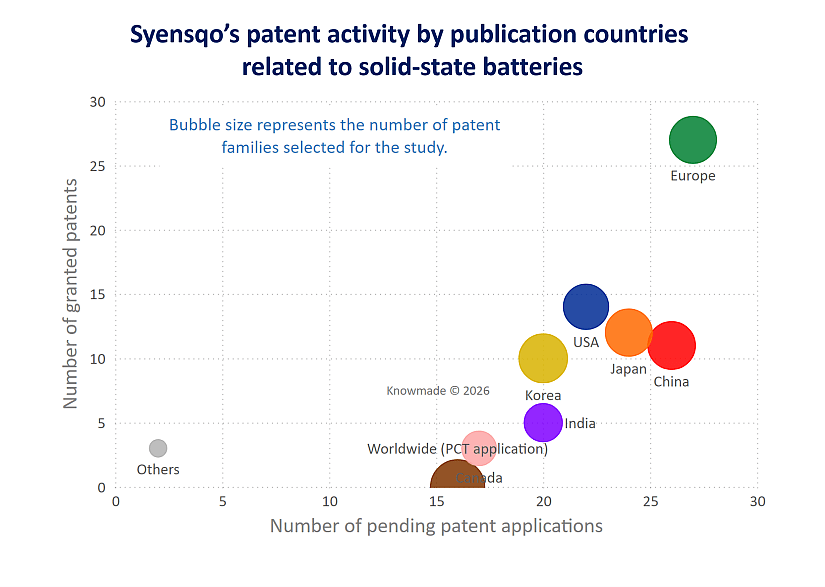
Figure 3: Number of granted patents and pending patent applications related to solid-state batteries held by Syensqo, by publication country.
Exploring Syensqo’s technology platforms for solid-state batteries
Syensqo’s patent portfolio in the field of solid-state batteries covers solid electrolytes and electrodes. The IP portfolio is largely dominated by electrolyte technologies, which account for 46 patent families, while electrode-related inventions represent a smaller but more recent segment with seven patent families.
The electrode-related patents, filed since 2023, focus on electrode formulations compatible with inorganic solid electrolytes, highlighting Syensqo’s efforts to address interfacial and mechanical challenges in solid-state battery electrodes. Three patent families describe electrodes comprising a specific polymer binder combined with an inorganic solid electrolyte, such as sulfide-based electrolytes or oxide garnet materials. In addition, four patent families relate to polymer binder compositions and their use in electrodes incorporating sulfide solid electrolytes.

Figure 4: Technical breakdown of Syensqo’s patent portfolio related to solid electrolytes.
The electrolyte patent portfolio, which represents the core of Syensqo’s activity, spans several material classes. The largest group concerns sulfide-based electrolytes, with 20 patent families filed between 2021 and 2025, covering compositions such as argyrodites and other lithium thiophosphate materials. These inventions notably cover argyrodite-type materials, including compositions such as Li₇−z−xMgₓPS₆−wXw (where X is a halogen), copper- or alkali-metal-modified argyrodites and Li₆PS₅X (where X = F, Cl, Br, or I). Some patents also focus on surface engineering strategies or composite materials, such as argyrodites mixed with cerium oxide (CeO₂) or iron oxide hydroxide (FeOOH), or argyrodites with an optimized thiol/carbonate surface ratio. Additional sulfide systems include sulfide glass ceramics, thio-LISICON materials (e.g., Li₄PS₄, Li₇P₃S₁₁, Li₃PS₄, Li₇PS₆, or Li₉.₆P₃S₁₂) and other lithium phosphorus sulfide compositions such as Li–P–S–O compounds and zinc-substituted lithium thiophosphates (Li₄−zZnₓP₂S₆). Another significant segment includes hybrid sulfide–polymer electrolytes (5 families, 2021–2025), which combine inorganic sulfide electrolytes with fluoropolymer components to improve processability and interfacial properties.
Earlier research efforts focused on polymer-based electrolytes, accounting for 16 patent families published between 2012 and 2025, notably involving fluoropolymer-based ionic conductive membranes and hybrid organic–inorganic systems, including cross-linked ionic conductive membranes comprising silane-modified fluorinated copolymers. Other developments include fluoropolymer hybrid composites, salt-free fluoropolymer membranes, and solid fluoropolymer electrolytes, highlighting Solvay’s historical expertise in fluorinated polymer materials.
The portfolio also includes oxide-based electrolytes (4 patent families, 2020–2021), mainly related to garnet-type materials and their preparation processes, as well as halide-based electrolytes (2 patent families, 2021–2023) involving lithium rare-earth halide compounds.
Overall, the technical breakdown shows a progressive diversification of electrolyte chemistries, moving from early polymer systems toward advanced inorganic and hybrid electrolytes with a strong emphasis on sulfide materials in recent years.
Syensqo’s innovation network for solid-state battery materials
Syensqo’s patent portfolio related to solid-state batteries also reflects a number of collaborative research activities with academic institutions and research organizations, particularly in the development of solid electrolytes. These IP collaborations span several material families, including sulfides, oxides, and polymer-based electrolytes.
In the field of sulfide electrolytes, Syensqo has collaborated with CNRS and Université de Picardie, resulting in three co-assigned patent families between 2021 and 2023. These inventions cover new preparation methods for Li-P-S-O solid electrolytes, methods for producing Li-P-S sulfide electrolytes, and new sulfide compositions such as zinc-substituted lithium thiophosphates (Li₄-zZnₓP₂S₆). In addition, a more recent collaboration with Eurocat led to one co-assigned patent family in 2025, related to a process for preparing lithium sulfide powder, a key precursor for sulfide-based solid electrolytes.
For oxide-based electrolytes, Syensqo collaborated with Université de Clermont-Ferrand, resulting in one co-assigned patent family in 2021 covering a process for the fluorination of LLZO-type garnet electrolytes, an approach aimed at improving the properties of garnet-based solid electrolytes.
Collaborations are particularly significant in the area of polymer electrolytes, reflecting Syensqo’s historical expertise in fluorinated polymer materials. A partnership with Politecnico di Torino resulted in five co-assigned patent families between 2019 and 2025 related to cross-linked ionic conductive membranes based on silane-modified fluorinated copolymers, fluoropolymer hybrid composites, and salt-free fluoropolymer membranes. More recently, Syensqo also collaborated with CEA, leading to two co-assigned patent families in 2025 describing ionic conductive membranes based on fluoropolymer hybrid organic–inorganic composites.

Figure 5: Overview of IP collaborations from Syensqo’s patent portfolio related to solid-state batteries.
Syensqo as an IP blocking leader in solid-state electrolytes
Syensqo holds a notable position in the solid-state battery technology landscape, particularly in the field of solid electrolytes, where its patent portfolio provides the company with a strong IP position that could restrict competitors’ freedom-to-operate. This positioning results from the combination of a significant contribution to the prior art, patents enforceable across multiple countries, and numerous pending patent applications worldwide, indicating both established IP protection and the continued expansion of its IP coverage.
The analysis of citations received by Syensqo’s patents highlights the technological impact of its IP portfolio. The number of patent families citing Syensqo’s patents (“citing patent families”) has increased steadily in recent years, reflecting the growing recognition of its inventions within the solid-state battery ecosystem. In total, the portfolio has received 226 citations, including 60 self-citations and 166 external citations, originating from around 100 different entities. The increasing number of citations observed in recent application years suggests that Syensqo’s technologies are becoming increasingly referenced by subsequent innovations in the field.
The diversity of organizations citing Syensqo’s patents (“citing entities”) also illustrates the broad technological relevance of its IP portfolio. Key citing entities include major industrial players and battery manufacturers such as Daikin Industries, CATL, LG Chem/LG Energy Solution, Samsung, Toyota, Kureha, Arkema, and Fujifilm, as well as leading research institutions including CEA, CNRS, the University of California, Politecnico di Torino, and Nanjing University. Emerging solid-state battery developers such as QuantumScape also appear among the citing entities, alongside specialized materials companies such as GRIREM Advanced Materials.
Overall, the growing citation activity and the diversity of citing organizations indicate that Syensqo’s patent portfolio plays a significant role in shaping ongoing technological developments in solid-state electrolytes, reinforcing its IP position as an influential actor within the global solid-state battery innovation landscape.

Figure 6: Time evolution of patent families citing Syensqo’s patent portfolio related to solid-state batteries by earliest application year. Note: Patents are typically published 18 months after their application date. Therefore, data from the 18 months preceding the selection date (March 2026) are incomplete.
Stay up to date by keeping a close eye on the fast-moving battery landscape
The evolution of the solid-state patent landscape highlights a profound transformation within the battery industry. The next technological breakthroughs, industrial investments, and geopolitical alignments will determine which players convert this potential into market dominance. Patent activity in the battery sector is thriving and remains highly attractive across all levels of the supply chain, particularly in key areas such as NMC, LFP and LMFP cathodes, silicon anodes, and solid-state batteries. In this fast-paced and competitive landscape, gaining a deep understanding of the patent ecosystem and the strategies of various industry players is becoming increasingly crucial.
To address this need, Knowmade publishes in-depth reports and provides monitoring services to track and analyze competitors’ R&D and IP strategies. These insights help identify the focus areas of industry leaders, emerging players, and start-ups, offering an early perspective on their strategic direction, technological investments, and product development efforts.
Press contact
contact@knowmade.fr
Le Drakkar, 2405 route des Dolines, 06560 Valbonne Sophia Antipolis, France
www.knowmade.com
About the author
Fleur Thissandier, PhD, works as Senior patent and technology analyst at KnowMade in the field of Materials Chemistry and Energy storage. She holds a PhD in Materials Chemistry and Electrochemistry from CEA/INAC, (Grenoble, France). She also holds a Chemistry Engineering Degree from the Superior National School of Chemistry (ENSCM Montpellier, France). Fleur previously worked in battery industry as R&D Engineer.
About KnowMade
KnowMade is a technology intelligence and IP strategy firm specializing in the analysis of patents and scientific publications. We assist innovative companies, investors, and research organizations in understanding the competitive landscape, anticipating technological trends, identifying opportunities and risks, improving their R&D, and shaping effective IP strategies.
KnowMade’s analysts combine their strong technology expertise and in-depth knowledge of patents with powerful analytics tools and methodologies to transform patent and scientific data into actionable insights to support decision-making in R&D, innovation, investment, and intellectual property.
KnowMade has solid expertise in Semiconductors and Packaging, Power Electronics, Batteries and Energy Management, RF and Wireless Communications, Photonics, MEMS, Sensing and Imaging, Medical Devices, Biotechnology, Pharmaceuticals, and Agri-Food.