
A patent-landscape insight on Thin-Film Surface Acoustic Wave filters
SOPHIA ANTIPOLIS, France, June 23, 2026 │ Thin-Film Surface Acoustic Wave (TFSAW) technology is moving from a specialist engineering topic to one of the most closely watched patent arenas in RF front-end filters. According to Knowmade’s RF Acoustic Wave Filters Patent Landscape Analysis 2026, TFSAW has already generated a sizable patent corpus and a highly asymmetric competitive structure: Murata is the clear IP leader, while Chinese companies are rapidly building patent positions around acoustic velocity stacks, transverse-mode suppression, thin-film transfer, packaging, and high-frequency operation.
Key Findings at a Glance
| 791 | 654 | 2,029 | 910 + 550 |
| TFSAW patent families | Active patent families | Patent publications | Granted patents + pending patent applications |
The TFSAW dataset analyzed in the RF Acoustic Wave Filters Patent Landscape Analysis report covers 152 patent assignees and 88 active IP players. This is large enough to indicate that TFSAW is no longer an experimental niche, yet concentrated enough to show clear leadership and fast-moving challenger clusters.
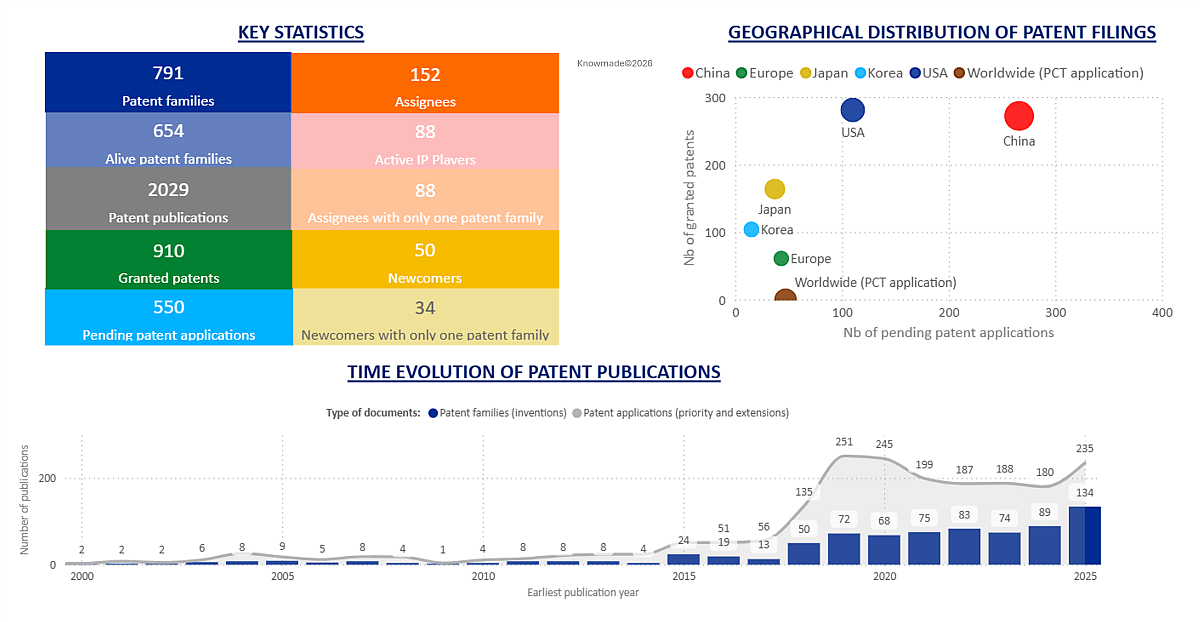
Figure 1: TFSAW patent overview: key statistics, geographic distribution, and publication trend.
Source: Knowmade RF Acoustic Wave Filters Patent Landscape Analysis 2026 report.
Why TFSAW Is Gaining Attention
RF filters are under growing pressure. Smartphones and connected devices must support more bands, higher frequencies, tighter coexistence requirements, smaller modules, and lower insertion loss. Conventional SAW remains mature, compact, and cost-efficient, but faces limits in frequency scaling, temperature stability, and spurious control. BAW and FBAR offer strong high-frequency performance, but usually involve greater fabrication complexity and cost. XBAR targets even higher-frequency and wideband needs, but remains an emerging platform still being industrially validated in many use cases.
TFSAW sits in the middle of this technology gap. By integrating thin piezoelectric films such as LiNbO3 or LiTaO3 onto engineered support substrates, TFSAW allows designers to tune film thickness, crystal orientation, acoustic velocity layers, thermal compensation, energy confinement, and packaging. The result is a SAW-derived platform with the potential to extend SAW performance toward higher-frequency, higher-Q, lower-drift, and more module-friendly applications.
| Technology | Main strengths | Main trade-offs | Typical strategic role | Patent signal |
| SAW / TC-SAW | Low cost, compact, mature, strong low-to-mid-band footprint | Frequency scaling and thermal drift constraints | Cost-efficient volume platform | Dense, mature prior art |
| TFSAW | Higher frequency potential, improved energy confinement, better integration options | Requires thin-film transfer, stack control, and spurious suppression | High-performance SAW extension | Fast-growing and increasingly crowded |
| BAW / FBAR | Strong high-frequency performance and good Q | More complex process and higher cost | High-band premium filtering | Strong US and incumbent portfolios |
| XBAR | Very high-frequency and wideband promise | Emerging manufacturability and adoption risk | Future high-band/wideband option | Aggressive new-platform patenting |
Murata: The Patent Fortress Around High-Performance SAW
The most striking feature of the TFSAW patent landscape is the gap between Murata and everyone else. Murata owns 239 active TFSAW patent families, while Qualcomm ranks second with 62. The remaining players form a long tail of Japanese, US, Korean, European and Chinese patent assignees. This is not a balanced race; it is a leader-driven field with an increasingly dense challenger layer.
Murata’s position should not be interpreted as a simple volume advantage. The company’s patent portfolio reflects a platform strategy. Its high-performance SAW roadmap is built around acoustic energy confinement, high-/low-velocity stacks, piezoelectric thin films, transverse-mode control, temperature behavior and module-level migration. Murata’s public I.H.P. SAW positioning also shows the commercial logic: extend SAW performance toward BAW-like territory while preserving advantages in cost, manufacturability and thermal behavior.
For later entrants, this creates a two-layer challenge. The first is technical: can they match insertion loss, selectivity, Q, power handling and temperature stability? The second is IP-related: can they design around a mature portfolio that covers not only resonators, but also stacks, boundary structures, filters and modules?
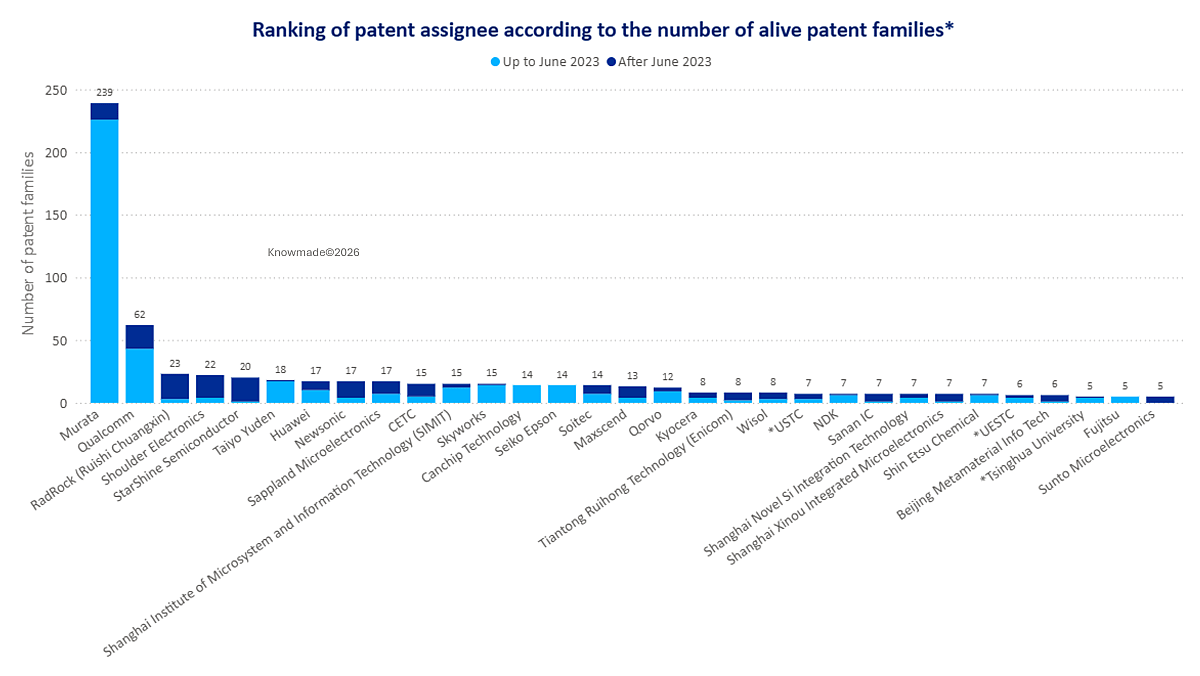
Figure 2: Leading TFSAW patent holders by number of active patent families, grouped by publication date (before and after June 2023). Murata is the clear leader, followed by Qualcomm and a large group of IP challengers.
Source: Knowmade RF Acoustic Wave Filters Patent Landscape Analysis 2026 report.
Different players, different strategic roles
Not every company approaches TFSAW in the same way. Qualcomm is best understood as a system-level RF front-end player. Its ultraSAW messaging emphasizes high-Q, low-loss and thermally stable filtering from 600 MHz to 2.7 GHz, and the technology is positioned within a broader RF front-end portfolio that includes modules and discrete filters. In patent terms, this points to a strategy that connects device-level acoustic performance to multiplexer, coexistence and modem-to-antenna integration requirements.
Soitec represents an upstream materials and substrate angle. Its POI platform is designed to enable high-performance RF filters through tailored multilayer piezoelectric substrates and Smart Cut technology. In TFSAW, this type of substrate-enabling IP can be strategically important even if the company is not the final filter vendor, because engineered substrates influence Q, loss, thermal behavior, film uniformity and manufacturability.
Skyworks, Qorvo, Taiyo Yuden, Wisol and other established RF/acoustic players occupy more selective positions. Some participate in TFSAW as an extension of existing SAW expertise; others keep TFSAW as an option within a broader SAW/BAW/module portfolio. The key point is that TFSAW is not only a device technology. It is becoming a multi-layer value-chain topic involving substrate suppliers, filter manufacturers, RF module integrators and system companies.
China’s TFSAW rise: a group move, not a single-player breakthrough
The Chinese TFSAW story is more nuanced than a simple challenger narrative. The data do not show one Chinese company replacing Murata as the new TFSAW leader. Instead, they show a group of Chinese assignees entering multiple technical subdomains at the same time.
RadRock, Shoulder Electronics, Starshine Semiconductor, Huawei, Newsonic, Sappland, CETC, SIMIT and Sanan IC all appear among the main TFSAW IP players. Several of them became particularly visible after 2020, with stronger patent publication activity from 2022 to 2025. This is consistent with a broader Chinese push in RF front-end localization and high-frequency acoustic-wave platforms.
The competitive meaning is important. China’s advantage is currently momentum and breadth, not yet mature enforceability. Many Chinese patent portfolios are pending-heavy and domestically concentrated. Their strategic task over the next three to five years is to convert filings into high-quality granted claims, extend coverage abroad, and build claim sets that map to manufacturable TFSAW process windows rather than only to isolated design concepts.
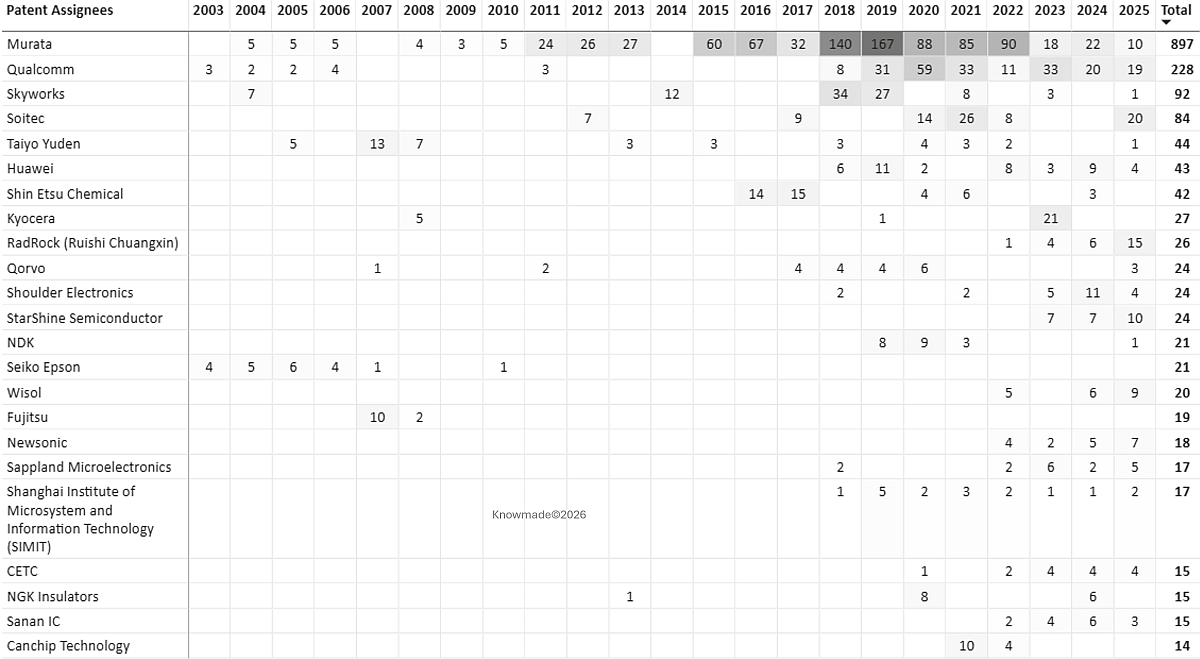
Figure 3: Evolution of TFSAW patent family publications over time for the main IP players. The chart highlights the recent acceleration in patenting activity by multiple Chinese challengers.
Source: Knowmade RF Acoustic Wave Filters Patent Landscape Analysis 2026.
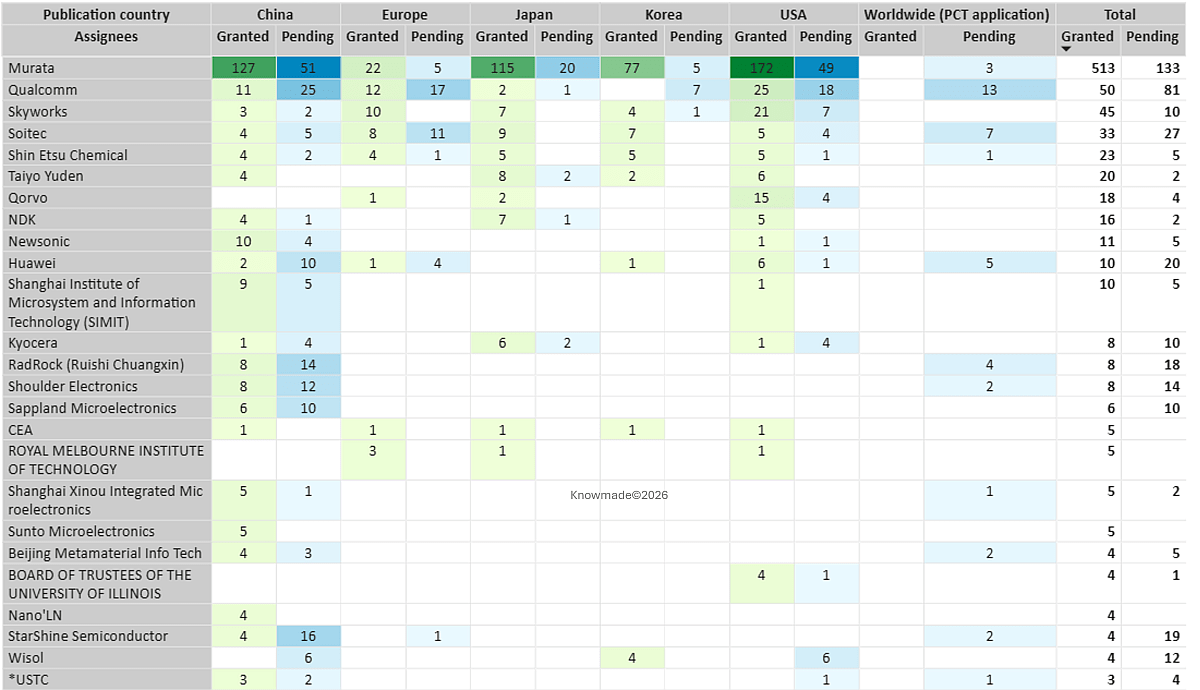
Figure 4: Main TFSAW patent holders by granted patents and pending patent applications across major filing jurisdictions. The figure highlights the contrast between players with broad, mature global patent portfolios and challengers characterized by a higher proportion of domestic pending applications.
Source: Knowmade RF Acoustic Wave Filters Patent Landscape Analysis 2026 report.
Recent patent innovation: five engineering fronts define the TFSAW race
Recent TFSAW patents show that innovation is concentrated less on a single resonator trick and more on platform engineering. The most relevant innovation fronts are: acoustic velocity layering and waveguiding; transverse-mode suppression; mass loading and IDT-region co-optimization; piezoelectric film/coupling engineering; and thin-film transfer plus packaging reliability.
High-/low-velocity and back-side high-velocity structures help confine acoustic energy in the piezoelectric film and strengthen Murata’s stack-level moat.
| Innovation front | Representative patent(s) | Assignee | Why it matters |
| Acoustic velocity stack and waveguiding | US12431855; US20250096777 | Murata | High-/low-velocity and back-side high-velocity structures help confine acoustic energy in the piezoelectric film and strengthen Murata’s stack-level moat. |
| Dual velocity layer architecture | US20250141431 | Huawei | SiO2 low-velocity and AlN/SiN high-velocity layers point to China’s move into core waveguide design rather than peripheral SAW modification. |
| Gradient velocity substrate engineering | US20240258983 | Sanan IC | Gradually reduced acoustic velocity from substrate to intermediate layers targets reflection mismatch, spurious control and manufacturable stack tuning. |
| Transverse-mode and edge suppression | CN119401974; CN115642895 | Starshine; RadRock | Local low-velocity filling and regional velocity profiling aim to reduce lateral leakage and passband ripple, a central problem as TFSAW moves higher in frequency. |
| High-frequency / wideband operation | CN118826689 | CETC | High-velocity layers between electrode and film target large-bandwidth operation above 6.3 GHz, showing that Chinese R&D is moving beyond low/mid-band SAW replacement. |
| Thin-film transfer and manufacturing | CN118646386 | Fudan University | He-ion implantation and laser debonding for LiNbO3 film transfer illustrate the process bottleneck behind scalable TFSAW production. |
| Packaging and acoustic environment control | US20250266804; CN118801841 | Qualcomm; Newsonic | Dome cavities, gas filling and dual-cover packaging show that reliability and acoustic environment control are becoming patentable differentiators. |
Outlook: TFSAW will not replace everything – but it will tighten FTO
TFSAW is not a universal replacement for SAW, BAW, FBAR, or XBAR. A more realistic outlook is selective adoption: TFSAW will extend the useful performance envelope of SAW into higher-frequency, lower-loss, lower-drift, and more highly integrated RF front-end applications, while BAW/FBAR remain strong in established high-band filters and XBAR continues to develop as a future wideband and high-frequency option.
The strategic consequence is that TFSAW will make freedom-to-operate more demanding. A commercial TFSAW filter is not protected, or exposed, at only one technical level. It may combine a thin LiTaO3 or LiNbO3 piezoelectric film, an engineered support substrate, high- and low-acoustic-velocity layers, IDT aperture and boundary design, temperature-control features, cavity or cap packaging, and module-level integration. As a result, entrants are more likely to face a stack of overlapping patent positions than a single, easily isolated blocking patent.
KnowMade made a similar point earlier this year in its dedicated insight, Murata’s Patent Litigation Against Maxscend: Interpreting the TF-SAW Battle from Shanghai, Seoul, to Munich. It highlighted how Murata’s actions across China, South Korea, and Germany reflect a layered protection strategy covering TF-SAW stack design, transverse-mode engineering, higher-order-mode suppression, and filter-system architecture. In other words, the commercial battle is already moving from device performance claims to enforceable IP control over the practical design space of TF-SAW filters.
This is the key message for the next three to five years: TFSAW growth will reward companies that can combine performance with differentiated design routes and carefully mapped FTO. Pending-heavy players will need to convert recent filings into high-quality granted patents across China, the United States, Japan, Korea, and Europe. At the same time, late entrants may need to explore alternative piezoelectric materials, different acoustic modes, hybrid SAW/BAW/XBAR architectures, or higher-level packaging and module innovations to avoid being trapped inside incumbent-controlled design corridors.
About the Report
The RF Acoustic Wave Filters Patent Landscape Analysis 2026 report provides patent and technology intelligence on SAW, BAW, TC-SAW, TFSAW, FBAR, SMR, XBAR, composite substrates, piezoelectric materials, and RF front-end module integration. The report analyzes more than 34,800 patents and patent applications grouped into more than 15,400 patent families, with coverage of patents published worldwide up to December 2025.
Press contact
contact@knowmade.fr
Le Drakkar, 2405 route des Dolines, 06560 Valbonne Sophia Antipolis, France
www.knowmade.com
About the author
Yanni Zhou, PhD., works at KnowMade in the field of RF Technologies for Wireless Communications, Sensing, and Imaging. She holds a Ph.D. in RF and Wireless Communication from the University of Lyon, INSA Lyon, INRIA, France, and an Engineer’s Degree in Electrical Engineering from INSA Lyon, France. Yanni previously worked at Nokia Bell Labs, Strategy & Technology, focusing on RF front-end systems and advanced sensing technologies. Her expertise also includes the design of radar sensing systems, enabling precise detection in complex and dynamic environments. She is the inventor of over 20 patents and has authored more than 10 scientific publications in the field.
About KnowMade
KnowMade is a technology intelligence and IP strategy firm specializing in the analysis of patents and scientific publications. We assist innovative companies, investors, and research organizations in understanding the competitive landscape, anticipating technological trends, identifying opportunities and risks, improving their R&D, and shaping effective IP strategies.
KnowMade’s analysts combine their strong technology expertise and in-depth knowledge of patents with powerful analytics tools and methodologies to transform patent and scientific data into actionable insights to support decision-making in R&D, innovation, investment, and intellectual property.
KnowMade has solid expertise in Semiconductors and Packaging, Power Electronics, Batteries and Energy Management, RF and Wireless Communications, Photonics, MEMS, Sensing and Imaging, Medical Devices, Biotechnology, Pharmaceuticals, and Agri-Food.