
Who are the key players and newcomers in the global IP race for LMFP batteries?
Publication January 2026
 |
|
 |
| Download Flyer | Download Sample | Discover the Dashboard |
Key Features
REPORT
PDF file with 400+ slides
- Global patenting trends, including time evolution of patent publications, countries of patent filings, etc.
- Main patent assignees and IP newcomers grouped by geographical area.
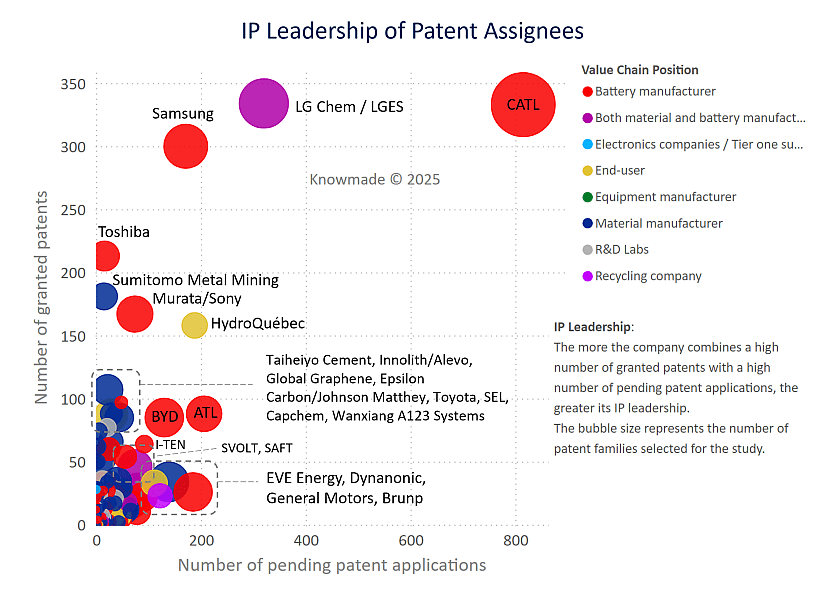
- Key players’ IP position and the relative strength of their patent portfolio.
- Patents categorized by supply chain segments (precursors, cathode active materials, cathode, battery cells).
- For each segment: IP dynamics, ranking of main patent assignees, IP newcomers, key IP players, key patents, and recent developments.
The report is provided under a multi-user license and can be shared internally among employees of the purchasing organization. Subsidiaries and joint ventures are excluded from this license.
DATABASE
Excel patent database containing the 7,800+ patent families analyzed in the report, including patent segmentations and hyperlinks to an updated online database.
DASHBOARD
Interactive dashboard (one-year access for unlimited authorized users)
- Transforming the analysis into a true decision-support tool.
- Enabling free and dynamic exploration of the patent landscape by applicant, technology, country/geographical area, publication period, and legal status.
- Allowing users to instantly drill down into key insights and tailor the analysis to the specific needs of each function (R&D, IP, strategy, business development).
Access to the interactive dashboard is granted for one year (12 months) to an unlimited number of authorized users within the purchasing organization. The dashboard must not be used to produce analyses or reports that are resold, sublicensed, or otherwise made available to any external user or entity outside the purchasing organization.
LMFP: A promising cathode material for next-generation Li-ion batteries witnessing a fast-growing and shifting patenting activity
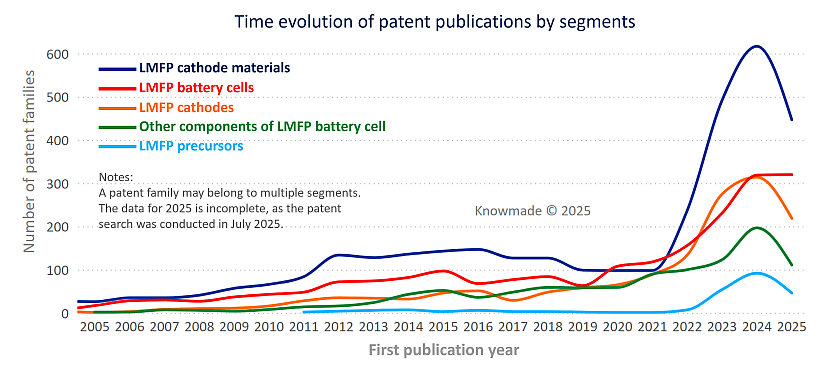
The burgeoning global demand for highly efficient and environmentally friendly energy storage solutions, driven primarily by the widespread adoption of electric vehicles (EVs) and large-scale energy storage systems (ESS), has made the development of advanced lithium-ion battery (LIB) cathode materials a critical focus. While the olivine-structured lithium iron phosphate (LFP) is widely valued for its high safety, stability, low cost, and environmental friendliness, its relatively low operating voltage, typically around 3.4 V (vs. Li/Li+), limits its energy density and falls short of the increasing requirements for high-performance applications. Lithium manganese iron phosphate (LMFP), developed by partially substituting iron with manganese in the olivine structure, has emerged as a promising alternative. This composition incorporates the high thermal stability and cost-effectiveness of LFP while leveraging the higher redox potential of manganese, resulting in a 10% to 20% higher energy density than LFP. Despite these advantages, LMFP faces intrinsic challenges notably poor electronic and ionic conductivity, sluggish lithium-ion diffusion kinetics, manganese dissolution issues, and capacity degradation related to the Jahn–Teller effect induced by Mn3+. Consequently, extensive research, supported by robust patent activity, has been performed for the last ten years.
In this context, the present report aims to provide a comprehensive analysis of the patent landscape related to the lithium manganese iron phosphate, from materials to battery cells. Knowmade’s analysts have selected and analyzed more than 7,800+ patent families (inventions) related to LMFP.
The general objectives of the present report are:
- to identify and map the key IP players in each chosen technological segment (precursors, cathode active materials, cathodes, battery cells).
- to assess the geographical distribution of patent families, current legal status of patents, helping stakeholders understand strategic positioning and navigate their competitive environment.
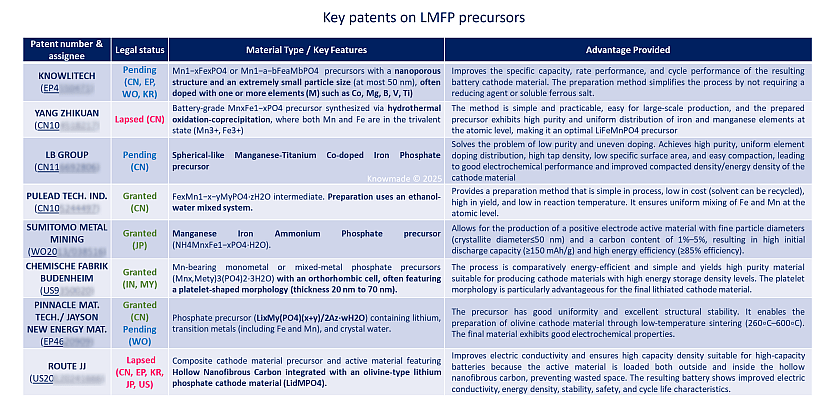
- to get an overview of key and recent patents across the value chain.
These strategic insights will support R&D, investment, and policy decisions in the evolving field of Li-ion battery.
Understanding the main trends, the key players’ IP position and IP strategy
IP competition analysis should reflect the vision of players with a strategy to enter and develop their business in the LMFP Li-ion battery market. In this report, Knowmade’s analysts provide a comprehensive overview of the competitive IP landscape and latest technological developments in this field. The report identifies the IP leaders, most active patent applicants, and new entrants in the IP landscape. It also sheds light on under-the-radar companies and new players in this field. The report covers IP dynamics and key trends in terms of patents applications, patent assignees, filing countries, and technological segment of interest (precursors, cathode active materials, cathode, battery cells, etc.). Dedicated sections of the report focus on the patent portfolios of key players from various countries.
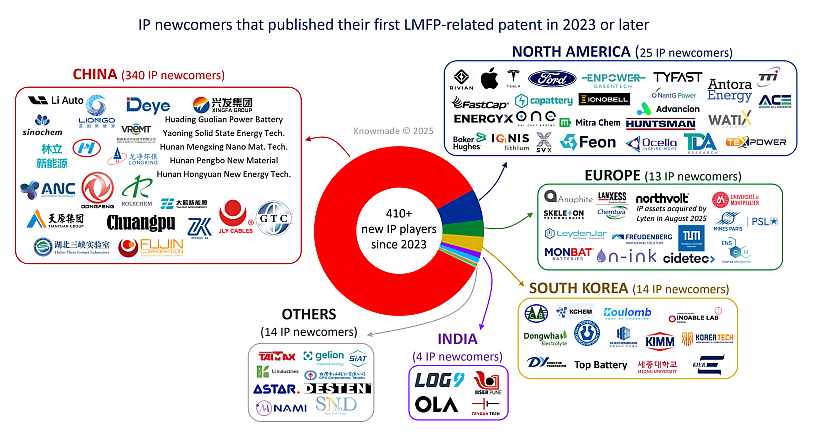
Identify the IP newcomers
Since 2023, Chinese entities have established themselves as dominant newcomers in the LMFP patent landscape. Over 410 new IP players have entered the LMFP patent landscape since 2023, with around 80% coming from China. More than 20 newcomers are non-Chinese start-ups. The main Chinese entrants are material and battery manufacturers, while other Asian newcomers are primarily R&D institutes and material producers. American newcomers include both start-ups and established companies, whereas other non-Asian entrants consist mainly of R&D organizations, battery manufacturers, and material suppliers. Dedicated sections of the report focus on the patent portfolios of IP new entrants from various countries.
Deep dive into key and recent patents across LMFP value chain
All patents selected for this study have been categorized by supply chain segment (precursor, cathode material, cathode, battery cells).
For each supply chain segment, this report includes a time-evolution of patent applications, main and key patent assignees, and a description of key and recently patented technologies. An understanding of the current technical challenges addressed in the patents is also presented.
Useful Excel patent database
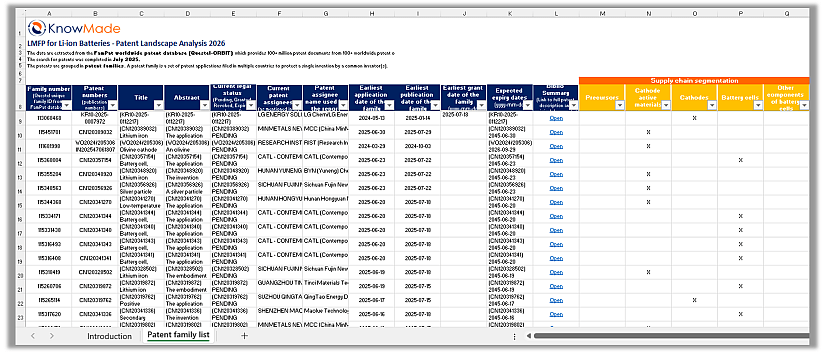
This report also includes an extensive Excel database with all patents analyzed in this study, including patent information (numbers, dates, assignees, title, abstract, etc.), hyperlinks to an updated online database (original documents, legal status, etc.), and supply chain segments (precursors, cathode active materials, cathodes, battery cells).
Interactive dashboard (optional)
Optional add-on: One-year access to the interactive dashboard for unlimited authorized users within your organization.
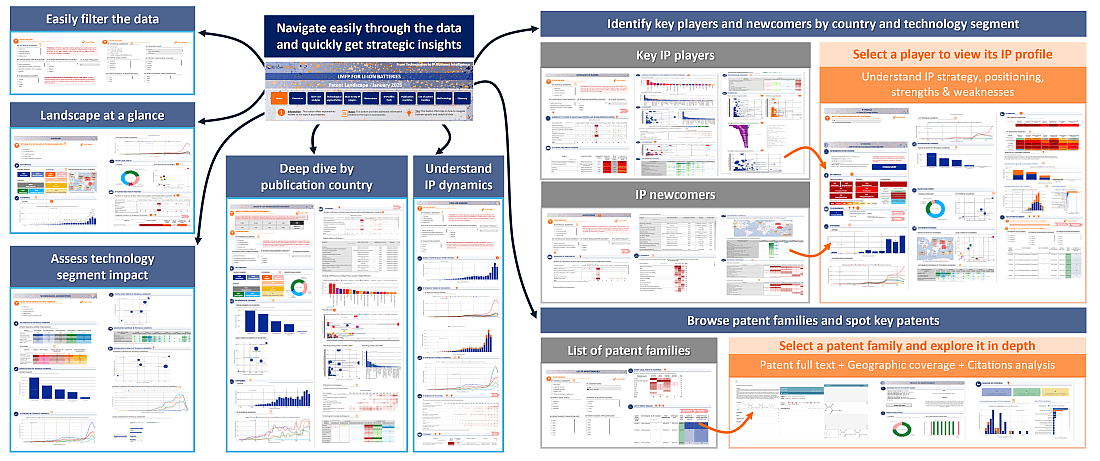
An interactive dashboard can be provided with this report, transforming the analysis into a true decision-support tool that puts you in control. It enables you to explore the patent landscape dynamically by applicant, technology, geography, publication period, or legal status, and to drill down instantly into key insights, from high-level trends to individual players and patents.
Tailored to the specific needs of R&D, IP, strategy, and business development teams, the dashboard delivers immediate visual answers to critical questions, enabling faster and more informed strategic decision-making across your organization.
Request a demo
Companies mentioned in the report (non-exhaustive)
INDUSTRIALS: CATL, LG Chem/LG Energy Solutions, Samsung, Dynanonic, BYD, EVE Energy, Murata/Sony, ATL, Guoxuan High Tech Power Energy/Gotion, SVOLT, Toyota, Taiheiyo Cement, Toshiba, Sumitomo Chemical/Tanaka Chemical, Tinci Materials Technology, Envision/AESC, Global Graphene, COSMX/COSLIGHT, Sumitomo Metal Mining, Sunwoda, General Motors, Rongbay Technology, HydroQuébec, Reliance New Energy/Lithium Werks, Epsilon Carbon/Johnson Matthey and more.
R&D LABORATORIES: SEL, Kyushu University, AIST, Tokyo Metropolotan University, Central South University, Institute of Physics, Tsinghua University, Beijing Institute of Technology, Hanyang University, UNIST, KAIST, RIST, KERI, CEA, CNRS, Fraunhofer, Université de Montréal, University of Chicago, University of Michigan, Lockheed Martin/UT-Battelle and more.
KnowMade supports innovation players with patent landscape and patent monitors, as follows in the battery sector:
- Li-ion Battery Cathode Active Materials Recycling Patent Landscape Analysis 2025
- Silicon Anode for Li-ion Batteries Patent Landscape Analysis 2024
- Halide Solid Electrolytes for Li-ion Batteries Patent Landscape Analysis 2024
- Silicon Anode Li-ion Batteries Patent Monitor
- Solid-state Batteries Patent Monitor